

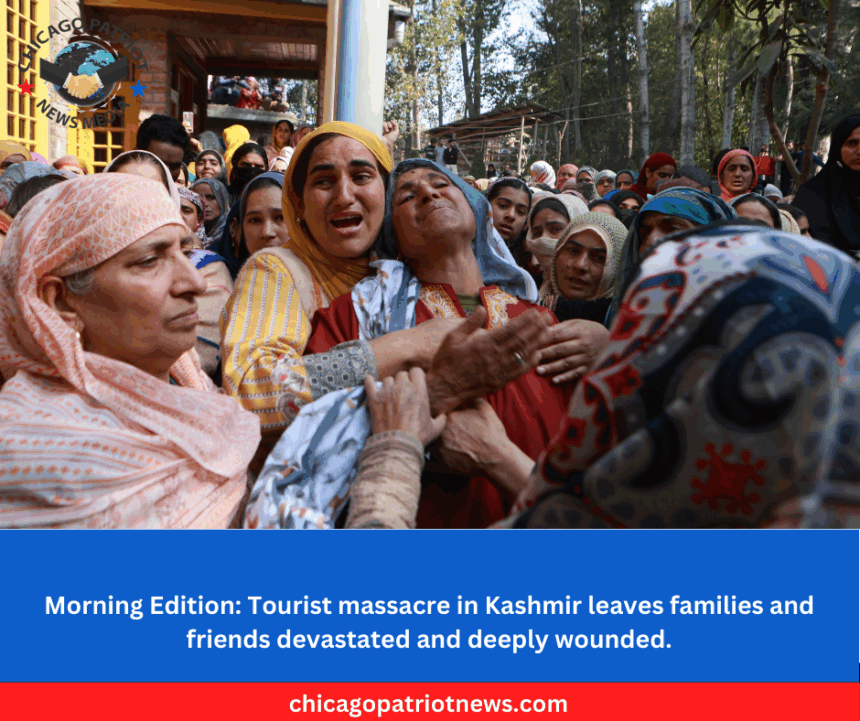
Chicago – April 27, 2025
One victim had recently returned home after spending decades working overseas, hoping to enjoy his retirement traveling and spending time with family. Another had hoped a visit to the scenic Indian-administered Kashmir would lift the spirits of his partially paralyzed wife.
Both men were among the 26 tourists who were killed by militants that week, in an attack that reopened old wounds between India and Pakistan, bringing the two nuclear-armed neighbors closer to potential military conflict.
Both countries claimed Kashmir in full, but each controlled only parts of it. They had fought three wars over the region, known for its stunning mountains and lush meadows, since gaining independence from Britain in 1947.
A violent insurgency had gripped the Indian-controlled part of Kashmir for decades, costing tens of thousands of lives. Militant groups had called for either independence or union with Pakistan. India had accused Pakistan of backing these groups, an allegation Islamabad denied.
The massacre on Tuesday, where, according to survivors, men were specifically targeted and shot at close range, added to a long history of bloodshed in the region.
Balachandran Menonparambil described feeling as though he had lost his “right hand” after his close friend of 60 years, Ramachandran Narayanamenon, was killed. Having spent much of his life working in Qatar, Narayanamenon had looked forward to enjoying a peaceful retirement, his friend said, describing him as a happy, kind, and dependable man.
“He was traveling with his wife Shiela, daughter Aarti, and two grandchildren, excited to spend quality time with his family,” Menonparambil, 70, shared.
He recalled how excited Narayanamenon had been during their last phone call before he boarded his flight to Kashmir on Monday. Less than a day later, Menonparambil learned of his death.
“I was watching the news on TV when reports from Kashmir started coming in. I tried calling him, but there was no answer,” he said. He then contacted Narayanamenon’s son Arvind, who gave him the devastating news: “Dad is gone.”
At the cremation, many came to offer their condolences. “Everyone kept asking me how I would manage; I told them half of me was gone. But he would always live in my heart,” he said.
Other survivors who spoke to local media said the gunmen had accused some of the victims of supporting Indian Prime Minister Narendra Modi.
In 2019, Modi’s Hindu-nationalist government had revoked Kashmir’s semi-autonomous status, sparking widespread anger in the Muslim-majority region.
Following the massacre, India quickly blamed Pakistan, downgrading diplomatic ties and suspending participation in a critical water-sharing agreement. Pakistan denied involvement and warned that any move to block or divert water would be treated as an act of war.
Meanwhile, Kavita Lele lost her husband Sanjay, 50, along with two cousins, Hemant Joshi, 45, and Atul Mone, 43, in the attack, her brother-in-law Rajesh Kadam said.
All three men, described as devoted fathers and key providers for their families, came from an area just outside Mumbai and had traveled together to Pahalgam.