

Chicago – May 01, 2025
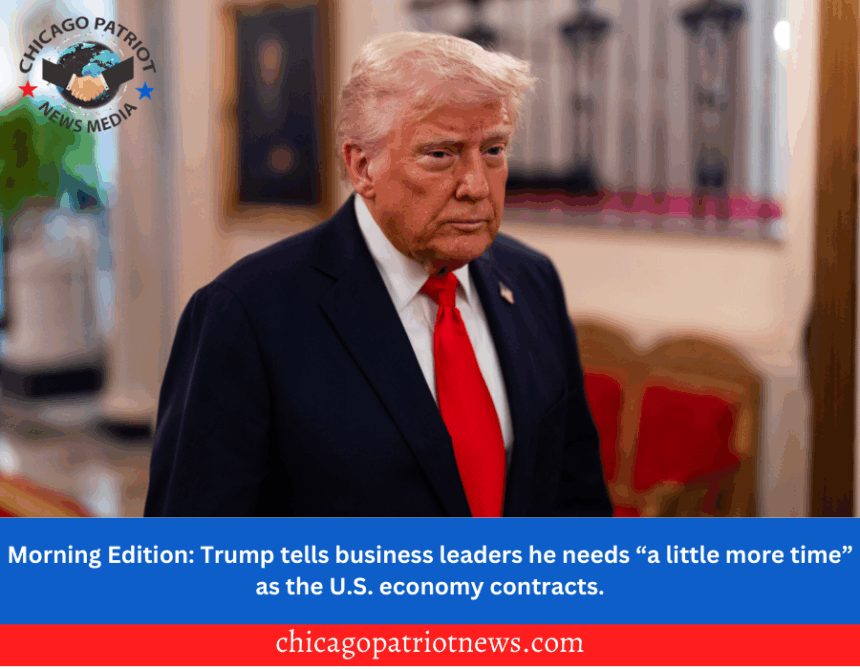
President Donald Trump had asked for more time to address the U.S. economy after it contracted for the first time in three years, raising fears of a potential recession.
He claimed the decline was misleading, attributing it to companies stockpiling imports in anticipation of his tariff policies.
Despite the contraction, Trump stated that $8 trillion (£6 trillion) in inward investment had been pledged, which he argued would help revive American manufacturing strength.
According to the U.S. Commerce Department, the economy had shrunk at an annual rate of 0.3%, a significant downturn from the previous quarter’s 2.4% growth. This economic slump came as Trump marked his 100th day in office, with opinion polls showing public dissatisfaction with his handling of the economy. Speaking at a White House event attended by business leaders on Wednesday, Trump placed blame on his Democratic predecessor, President Joe Biden, for the weak GDP numbers.
“This is Biden’s economy because we took over on January 20th,” Trump had said. “I think you have to give us a little bit of time to get moving.”
The economic decline followed Trump’s imposition of import tariffs, which had disrupted global trade and financial markets.
Democrats criticized Trump’s attempt to shift responsibility. Congressman Hakeem Jeffries, the minority leader of the U.S. House of Representatives, responded, “This is not Joe Biden’s economy, Donald, it is your economy. It is the Trump economy, it is a failed economy and the American people know it.”
During the same White House event, Trump had promoted upcoming investments in technology, healthcare, and infrastructure. He introduced top executives from major companies, including Hyundai’s Jose Munoz, Toyota’s Ted Ogawa, and Johnson & Johnson’s Joaquin Duato.
He also urged Congress to pass his tax legislation, which proposed trillions of dollars in tax and spending cuts, though the bill faced resistance from both Democrats and some Republicans.