

Chicago Sunday – May 11, 2025
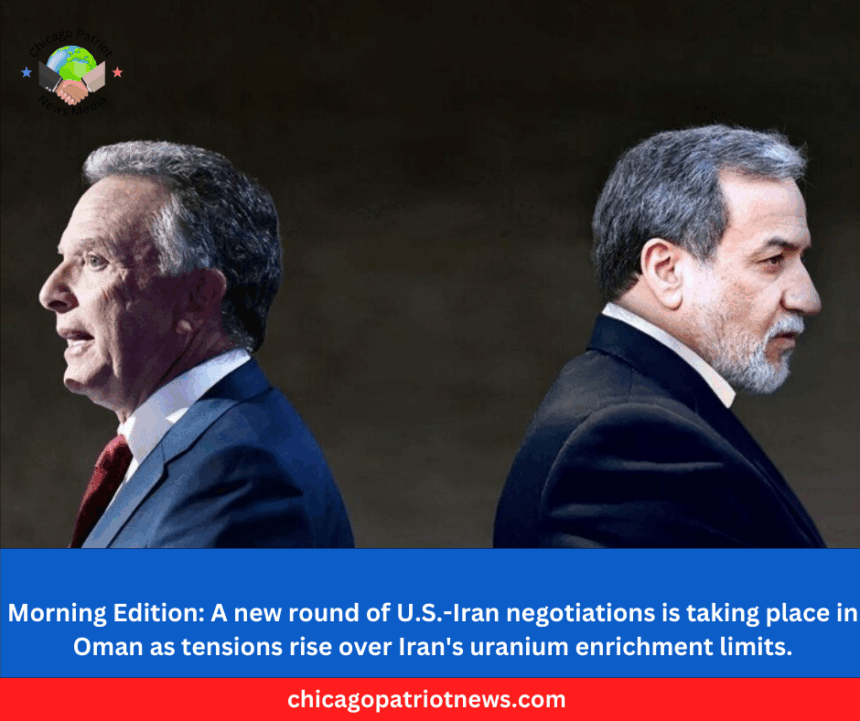
A fourth round of indirect negotiations between the United States and Iran over Tehran’s nuclear program has begun in Oman, as reported by Iranian state media. The goal of the discussions is to bridge key disagreements that could jeopardize the already fragile talks.
The meetings, mediated by the Omani Foreign Minister, focus on Iran’s nuclear activities and the potential lifting of U.S. sanctions. Although the fact that the talks are happening marks a diplomatic breakthrough, being the highest-level engagement in years, there has been little indication of real progress.
Both sides have voiced support for a diplomatic resolution. However, a major sticking point remains: Iran’s insistence on continuing its uranium enrichment program, which it claims is for peaceful purposes. The U.S., on the other hand, considers any enrichment a non-negotiable issue.
U.S. President Donald Trump, who is scheduled to visit the Middle East next week, has warned that military action, potentially with Israeli support, remains an option if Iran does not agree to terms.
While Iran has confirmed that the Oman-hosted talks are underway, the U.S. has not commented publicly. Iran’s Foreign Minister Abbas Araghchi is leading his country’s delegation and has criticized what he described as inconsistent positions from the U.S., calling it one of the obstacles to progress. “We’ve made our limits clear,” Araghchi told Fars news agency.
U.S. special envoy Steve Witkoff, leading the American delegation, said the talks must produce results or they will be discontinued. In a statement to Breitbart, he reaffirmed that the U.S. will not accept any uranium enrichment by Iran, declaring it a firm red line. Iran continues to argue that its nuclear program is solely for energy and not for building weapons.
Meanwhile, Rafael Grossi, Director General of the International Atomic Energy Agency (IAEA), warned last month that Iran is alarmingly close to having the capability to produce a nuclear weapon. Speaking to France’s Le Monde, he said, “It’s like a puzzle, they have the pieces, and one day they could fit them together.”