

Chicago – November 03, 2025
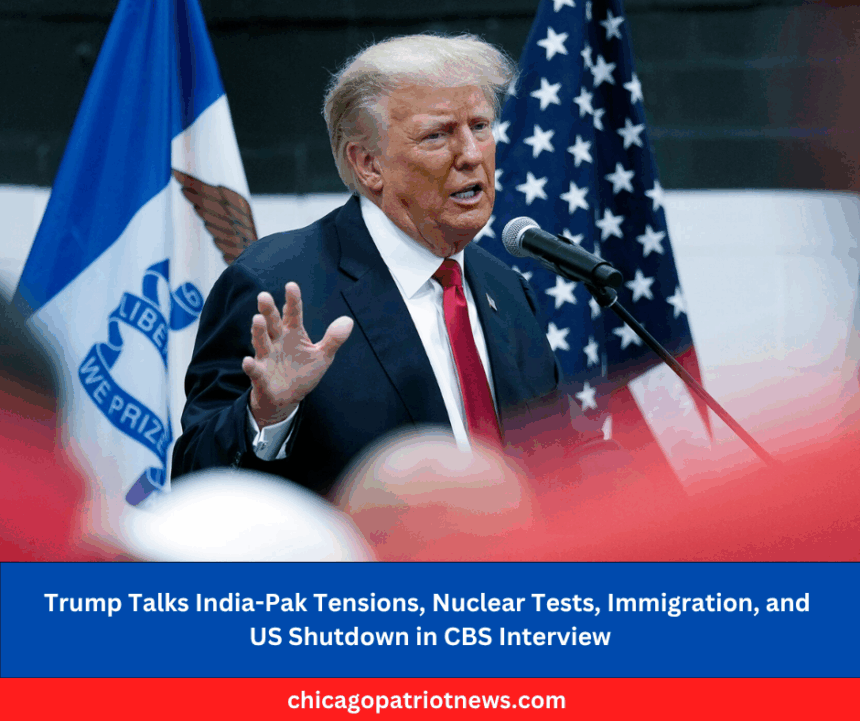
US President Donald Trump appeared on CBS’s 60 Minutes in his first interview since settling a lawsuit with the network. During the conversation, he addressed a wide range of international and domestic issues, including the India-Pakistan conflict, nuclear testing by Russia and China, immigration policy, and the continuing government shutdown in the United States.
Trump claimed that he personally helped prevent a potential nuclear confrontation between India and Pakistan, crediting his trade negotiations and diplomatic influence. He stated that his administration’s policies “stopped them from going to war.” However, officials in New Delhi have repeatedly denied such claims, maintaining that India’s handling of its regional relations is independent of foreign mediation.
Turning to global security, Trump alleged that both Russia and China were secretly conducting underground nuclear tests. He insisted that the United States must take stronger action toward denuclearisation and ensure it maintains its strategic advantage. Trump asserted that while the US still holds the world’s largest nuclear arsenal, China is expanding its capacity rapidly and could soon reach parity.
On immigration, Trump took a victory lap, claiming that his policies had effectively closed the US-Mexico border. He told CBS that for five months “zero people” had crossed illegally, describing it as a record achievement. Analysts, however, have disputed this claim, citing continued movement across the southern border.
When asked about Iran, Trump said his administration had “blasted the hell out of them” to prevent Tehran from developing nuclear weapons. He linked this to the broader stability of the Middle East, arguing that American pressure had curtailed Iran’s ambitions and contributed to peace in the region.
Trump also used the interview to criticise Democrats for the ongoing government shutdown, which has stretched into its sixth week. He placed full responsibility on the opposition, saying they were blocking negotiations and refusing to approve necessary budget extensions. On healthcare, he revisited his long-standing criticism of Obamacare, describing it as “bad healthcare at far too high a price,” and blamed late Republican Senator John McCain for preventing its repeal.
Throughout the interview, Trump also revisited several personal and political rivalries. He called former President Barack Obama “a lousy president” and accused him of leaving behind a weak policy framework. He also attacked New York mayoral candidate Zohran Mamdani, referring to him as “a Communist,” and hinted that he might take a more assertive approach toward Venezuela if given the opportunity.
The CBS interview gave Trump an opportunity to reintroduce himself as a decisive leader focused on national strength and global security. It reflected his ongoing effort to shape the Republican message in the run-up to future elections, blending familiar grievances with new claims of success and international influence.