
By using this site, you agree to the Privacy Policy and Terms of Use.
Accept
Chicago Patriot News MediaChicago Patriot News MediaChicago Patriot News Media
  • Advertise with us
  • Newsletters
  • Deal
Reading: Morning Edition: How DY Chandrachud Ex-Chief Justice defended Modi’s illegal abrogation of Article 370 verdict in BBC interview?
Share
Font ResizerAa
Chicago Patriot News MediaChicago Patriot News Media
Font ResizerAa
  • Politics
  • Advertise with us
  • Newsletters
  • Deal
  • Advertise
© 2022 Foxiz News Network. Ruby Design Company. All Rights Reserved.
Chicago Patriot News Media > Blog > India > Morning Edition: How DY Chandrachud Ex-Chief Justice defended Modi’s illegal abrogation of Article 370 verdict in BBC interview?
India

Morning Edition: How DY Chandrachud Ex-Chief Justice defended Modi’s illegal abrogation of Article 370 verdict in BBC interview?

Mujeeb Osman
Last updated: March 8, 2025 6:04 am
Mujeeb Osman 12 months ago
Share
SHARE

Chicago – March 08, 2025

Former Chief Justice of India DY Chandrachud defended his stance on Article 370, saying it was always intended as a “transitional provision” in the Constitution.

He was questioned whether 75 years was too short a period to abrogate such a provision, emphasising that it was meant to fade away and merge with the Constitution over time.

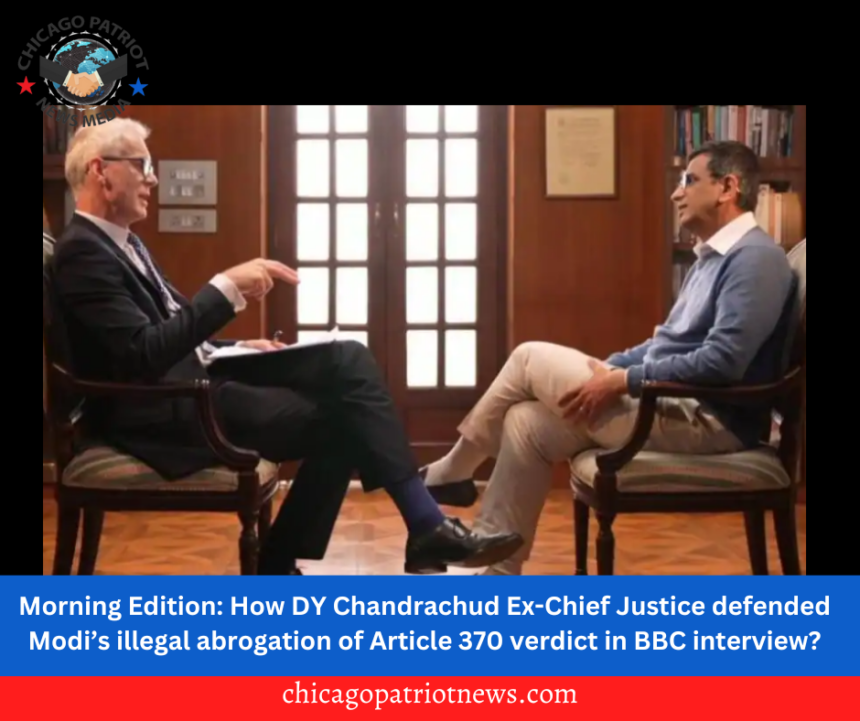
Chandrachud was responding to BBC journalist Stephen Sackur’s question in an interview about legal scholars’ stance on Article 370 led by the Modi government.

A Constitution bench of the Supreme Court, headed by Chandrachud, on December 13 unanimously upheld the power of the President to abrogate Article 370 in August 2019 showing his unwavering support to PM Modi.

This decision led to the reorganisation of the full-fledged state of Jammu and Kashmir into two union territories and the removal of its special privileges while many lost their basic human right.

Chandrachud was asked, “Article 370 was part of the Constitution, which guaranteed the special status, the autonomy of the state of Jammu and Kashmir, now that had been out the place of the very inception of the modern state of India. You agreed that the government had a right to abrogate Article 370. Many legal scholars were deeply disappointed with your decision because they felt you had failed to uphold the Constitution. Explained to me why you took the decision you did.”

Stephen Sackur also questioned how legal scholars felt that the decision failed to uphold the Constitution.

Chandrachud explained that as the author of one of the judgments in the Article 370 case, a judge must refrain from defending or critiquing their own decisions. He clarified that Article 370, originally part of transitional provisions in the Constitution, was meant to eventually fade away and merge with the rest of the Constitution.

“Since I was the author of one of the judgments in the case, a judge by their very nature of profession has some restraints on either defending or critiquing their judgments… Article 370 of the Constitution when it was introduced into the Constitution at the birth of the Constitution was part of a chapter which is titled ‘transitional arrangments’ or ‘transitional provisions’. It was later renamed as ‘temporary and transitional provisions’, and therefore at the birth of the Constitution, the assumption was that what was transitional would have to fade away and have to merge with the overall text, the context of the Constitution. Now is 75 plus years too less for abrogating a transitional provision,” replied Chandrachud.

He said the Supreme Court acknowledged that if the elected government decides to abrogate a provision meant to be transitional, it is acceptable.


You Might Also Like

Morning Edition: Russia prepared to divert oil to India as Middle East conflict disrupts flows

Night Line: India and Canada Reboot Ties with Landmark Billion‑Dollar Nuclear Energy Deal

Morning Edition: Energy-hungry India tells Carney ‘we are willing to buy whatever Canada is offering’

Night Line: Uttar Pradesh Couple Sentenced to Death in Child Exploitation Case Called “Rarest of the Rare”

Morning Edition: Bollywood as a Narrative Machine: Industry, Ideology, and Cultural Production

Share This Article
Facebook Twitter Email Print
By Mujeeb Osman
With 26 years of journalism experience across Urdu and English newspapers, he has built a reputation for thoughtful, community-focused reporting. Mujeeb Osman previously served as the Chicago in-charge of The Muslim Observer, where he covered local, national, and international issues impacting diverse communities. At Chicago Patriot News, he continues his commitment to delivering accurate, balanced, and compelling stories. His work reflects a deep interest in immigration issues, public policy, and American politics, areas he has followed closely throughout his career. At Chicago Patriot News, he continues his commitment to delivering accurate, balanced, and compelling stories that illuminate the challenges and perspectives shaping today’s public discourse.
Previous Article Morning Edition: President Trump signs executive action targeting public service loan program
Next Article Morning Edition: Death Toll Rises in Ukraine as Russia Unleashes Missile and Drone Attacks

Our Mission

Search CPN

Latest News

  • Morning Edition: Pam Bondi Remains U.S. Attorney General Amid Ongoing Scrutiny
  • Morning Edition: Trump looks to turn attention to Western Hemisphere at Americas summit
  • Night Line: Trump grants India 30-Day permission to buy Russian oil; Russia says no discount
  • Night Line: Iran President Pezeshkian Apologizes for Strikes on Neighbors Amid Escalating Regional Conflict
  • Night Line: Trump Hosts ‘Shield of Americas’ Summit with 12 Latin Leaders
  • Morning Edition: Justice Department Posts 3 FBI Memos Alleging Unverified Sexual Abuse by Donald Trump

Disclaimer

Chicago Patriot News MediaChicago Patriot News Media
Follow US
© 2025 CPN. All Rights Reserved by Chicagopatriotnews.com
Welcome Back!

Sign in to your account

Register Lost your password?
