
Chicago – December 12, 2025
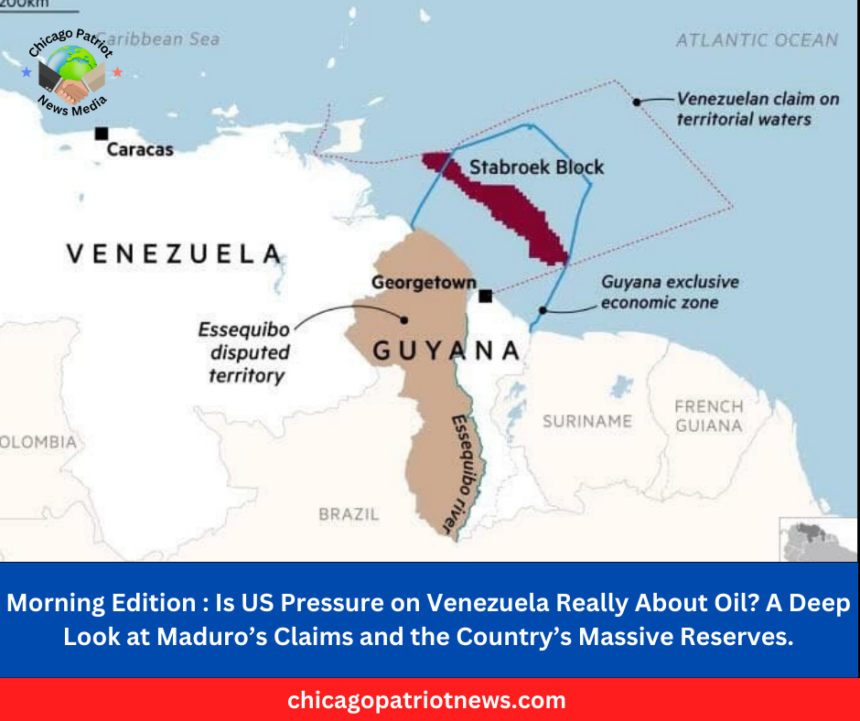
Venezuelan President Nicolás Maduro claims that rising pressure from the United States is driven by one primary motive: Washington’s desire to take control of Venezuela’s enormous oil reserves.
This week, tensions escalated when the US military seized an oil tanker allegedly transporting Venezuelan crude in violation of American sanctions. US officials also warned that other vessels could face similar action. The seizure follows recent strikes on Venezuelan boats, which the US says were engaged in drug trafficking. President Donald Trump has repeatedly urged Maduro to step down, accusing him of sending criminals and narcotics into the US.
These developments raise a critical question: Is Venezuela’s oil the real prize? And is it worth the confrontation?
Venezuela holds the world’s largest proven oil reserves, estimated at 303 billion barrels surpassing even Saudi Arabia. However, the country’s actual production is a fraction of its potential.
Oil output has plunged since the early 2000s, largely due to increasing state control under former leader Hugo Chávez and later Maduro. Their policies led to a mass departure of experienced workers from PDVSA, the state oil company, crippling its operational capacity.
A few Western firms, including US energy giant Chevron, still maintain a limited presence in Venezuela. Yet their operations have been significantly scaled back as Washington expanded sanctions, targeting Venezuela’s oil exports to restrict Maduro’s access to revenue.
The sanctions, first introduced by the Obama administration in 2015 over alleged human rights abuses, have isolated Venezuela from vital international investment and denied it access to essential parts and equipment. According to Callum Macpherson, head of commodities at Investec, the biggest obstacle for Venezuela is its deteriorating infrastructure.
In November, Venezuela produced around 860,000 barrels per day, according to the International Energy Agency’s latest report. That is only about one-third of its output a decade ago and represents less than 1% of global oil consumption.
Despite possessing unparalleled reserves, Venezuela’s ability to benefit from its oil wealth remains severely constrained by political turmoil, sanctions, and a collapsing energy sector.