
Chicago – December 06, 2025
The U.S. Supreme Court announced Friday that it will review one of President Trump’s most controversial immigration actions: his challenge to America’s long-standing doctrine of birthright citizenship. This decision sets up a potentially historic case that could redefine a 127-year interpretation of who automatically qualifies as a U.S. citizen.
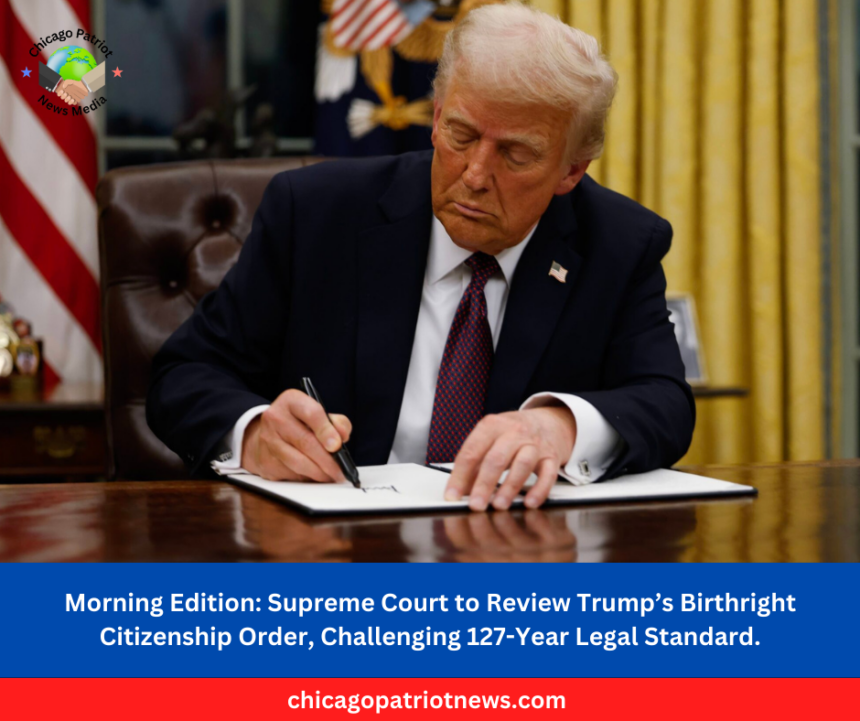
The administration contends that the United States has been granting citizenship too broadly to children born to non-citizens. On his first day back in office, Trump signed an executive order denying citizenship to babies born to people “unlawfully present” in the country or to non-citizens visiting temporarily, including tourists. The rule would only apply to children born 30 days after the order took effect on January 20, 2025.
So far, four federal courts and two appellate courts have blocked the order, pointing to the 14th Amendment, which grants citizenship to “all persons born or naturalized in the United States, and subject to the jurisdiction thereof.” Judges have consistently ruled that this constitutional language protects birthright citizenship.
Earlier this year, the Supreme Court issued a separate ruling limiting the power of lower courts to impose nationwide injunctions. However, it avoided ruling on the core question: whether Trump’s executive order violates the Constitution or whether birthright citizenship should be narrowed.
According to administration attorneys, individuals in the U.S. temporarily are not fully “subject to the jurisdiction” of the United States and therefore should not pass citizenship to their children. They argue that the current practice encourages “birth tourism,” a term used to describe non-residents giving birth in the U.S. to obtain citizenship for their children. While the government does not collect official data on this, the Center for Immigration Studies estimates over 20,000 such births annually.
Despite repeated losses in lower courts, the administration now has the opportunity to present its case directly to the nation’s highest court this spring.
César Cuauhtémoc García Hernández, an immigration law professor at Ohio State University, says this moment reflects the President’s long-term strategy. “Those defeats in the lower courts are battles the administration is willing to lose because the real objective is a receptive Supreme Court,” he explains.
However, García Hernández cautions that a favorable outcome for the administration is not guaranteed.
He notes that while automatic citizenship by birthplace is common in North America and across the Western Hemisphere, it is less common globally. Still, he emphasizes that “the guiding factor must be the text of the 14th Amendment and its relevance in modern America.”
As the Supreme Court prepares to hear arguments, the case promises to ignite a nationwide debate over constitutional interpretation, immigration policy, and the future of birthright citizenship in the United States.