
Chicago – November 15, 2025
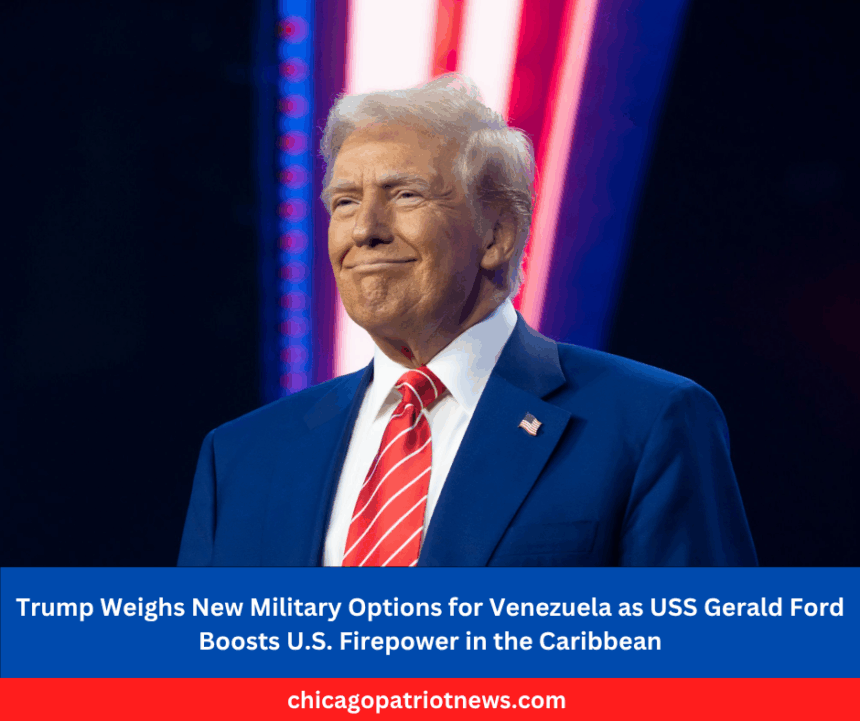
President Donald Trump has been briefed on a fresh set of military options for Venezuela, following the arrival of the USS Gerald Ford in the Caribbean. The aircraft carrier, the largest in the world, brings about 60 combat-ready planes and significantly boosts the American military presence in Latin America. With this deployment, roughly 15,000 U.S. personnel are now positioned across the region.
Officials familiar with the briefing stressed that the meeting should not be seen as a sign that military action is about to begin. They described it as part of routine contingency planning, updated to match the expanded U.S. capability in the area.
Inside the briefing, Trump was presented with a wide spectrum of choices. Some involved taking no direct action. Others proposed targeted strikes on Venezuelan ports, airports, and military bases believed to be linked to drug-smuggling routes. A far more extreme option, which officials emphasized remains highly unlikely, involved sending special operations teams to capture or eliminate President Nicolás Maduro and senior members of his government.
The session at the White House was led by Defense Secretary Pete Hegseth and Gen. Dan Caine, the Chairman of the Joint Chiefs of Staff. Senior diplomatic and intelligence figures were not present due to travel commitments, but officials said they were updated separately.
A day after the briefing, Hegseth publicly confirmed that Washington’s expanded posture in the region now carries the name Operation Southern Spear. The move reflects the Trump administration’s increasing focus on Latin America, particularly the nexus of drug trafficking, political instability, and migration pressures.
Trump has repeatedly accused Maduro of enabling narcotics networks and contributing to the flow of migrants toward the U.S. He has also continued to call on the Venezuelan leader to resign. Still, advisers acknowledge that forcing Maduro out could create a power vacuum and trigger a new phase of instability inside the country.
Legal uncertainty also hangs over any potential operation. Senators were quietly shown a classified Pentagon target list last month, but lawmakers say they were told that the administration’s current legal justification only applies to U.S. strikes on drug-carrying boats—not to broader military action against Venezuelan state assets.
For now, officials describe the updated briefing as precautionary planning rather than a precursor to intervention. With the White House and Pentagon declining public comment, the future course of U.S. policy toward Venezuela remains unclear.