
Chicago – November 2, 2025
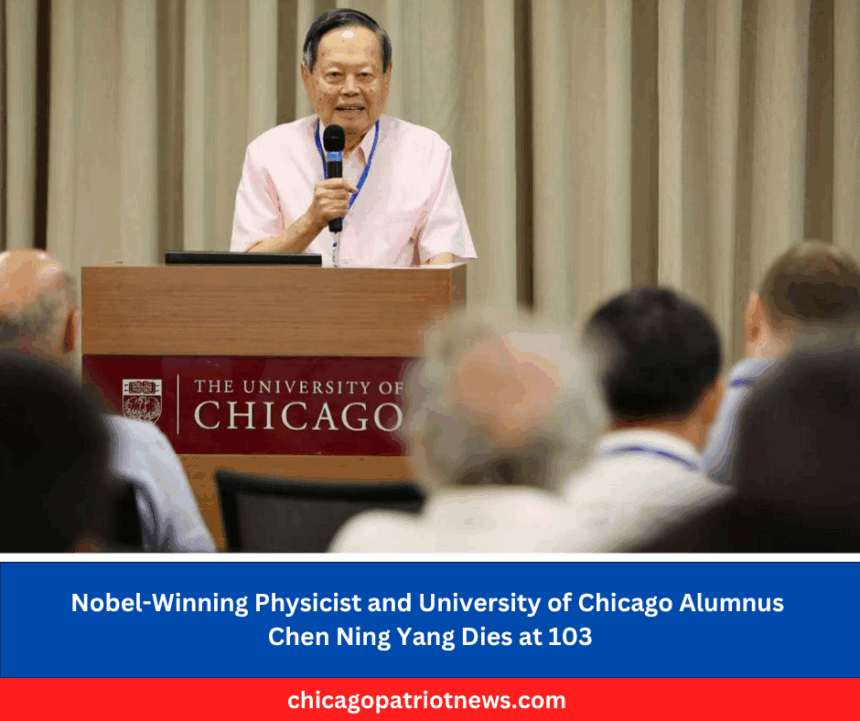
Chen Ning Yang, PhD’48, one of the most celebrated physicists of the 20th century, passed away in Beijing on October 18 at the age of 103. His pioneering ideas reshaped modern physics, earning him international acclaim and the 1957 Nobel Prize in Physics, which he shared with fellow University of Chicago alumnus Tsung-Dao Lee.
Yang’s journey in science began at the University of Chicago in 1946, where he arrived from China to pursue doctoral research. Under the mentorship of renowned scientists such as Enrico Fermi and Edward Teller, he developed a deep fascination with the symmetry of natural laws. His Ph.D. dissertation, focused on symmetry and natural phenomena, became the cornerstone of his later theoretical breakthroughs.
In the years following his graduation, Yang briefly taught at UChicago before joining the Institute for Advanced Study in Princeton. There, he worked alongside some of the era’s greatest minds, including Robert Oppenheimer. In 1954, together with Robert Mills, Yang formulated the Yang–Mills theory, a discovery that provided the mathematical framework for the Standard Model of particle physics — the foundation for much of today’s understanding of fundamental forces.
Two years later, his collaboration with Tsung-Dao Lee led to another scientific revolution. They proposed that the long-held principle of “parity conservation” might not apply to weak nuclear interactions. When experimental physicist Chien-Shiung Wu confirmed this, it overturned one of physics’ most entrenched assumptions and secured Yang and Lee the Nobel Prize in 1957.
Yang went on to make major contributions in statistical mechanics, quantum field theory, and condensed matter physics. He taught for decades at Stony Brook University before returning to China, where he joined Tsinghua University and helped shape the country’s modern scientific community.
Beyond his research, Yang was devoted to advancing academic cooperation between China and the United States. He played a key role in establishing exchange programs and research collaborations that allowed Chinese scholars to study and work abroad.
Even in later years, Yang remained connected to the University of Chicago. He attended the 2010 opening of UChicago’s Center in Beijing and participated in early academic events there. “C.N. Yang’s visionary work transformed our understanding of the universe,” said Ka Yee C. Lee, interim dean of the Physical Sciences Division. “His legacy endures as an inspiration to generations of scientists and students around the world.”