
By using this site, you agree to the Privacy Policy and Terms of Use.
Accept
Chicago Patriot News MediaChicago Patriot News MediaChicago Patriot News Media
  • Advertise with us
  • Newsletters
  • Deal
Reading: Morning Edition: How the divide between Muslims And Hindus grew in the 19th century and led to separation of sub continent
Share
Font ResizerAa
Chicago Patriot News MediaChicago Patriot News Media
Font ResizerAa
  • Politics
  • Advertise with us
  • Newsletters
  • Deal
  • Advertise
© 2022 Foxiz News Network. Ruby Design Company. All Rights Reserved.
Chicago Patriot News Media > Blog > India > Morning Edition: How the divide between Muslims And Hindus grew in the 19th century and led to separation of sub continent
India

Morning Edition: How the divide between Muslims And Hindus grew in the 19th century and led to separation of sub continent

Mujeeb Osman
Last updated: April 26, 2025 6:09 am
Mujeeb Osman 11 months ago
Share
SHARE

Chicago – April 26, 2025

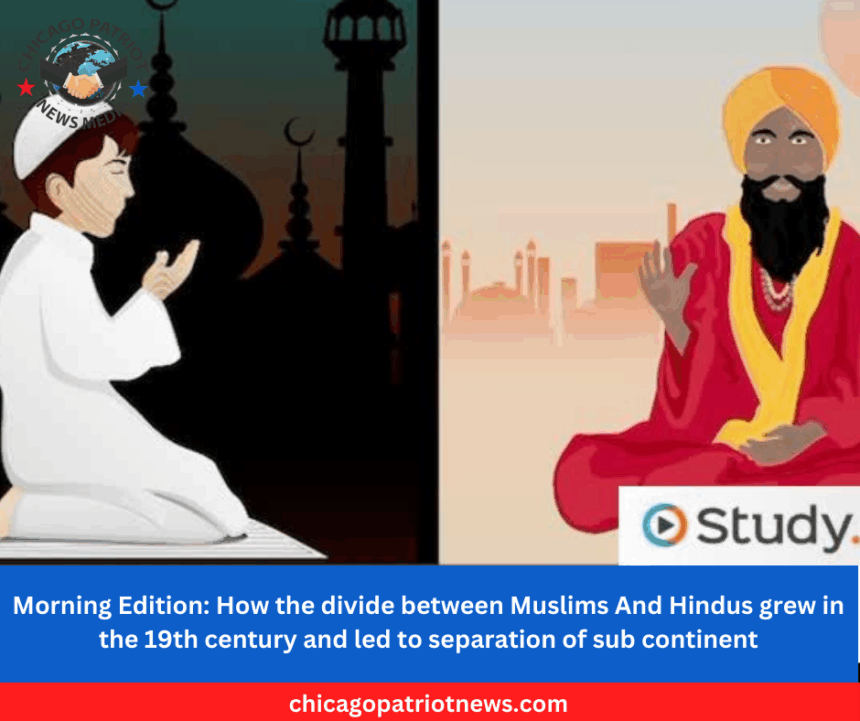
The 19th century marked a significant turning point in Hindu-Muslim relations in India, with growing divisions influenced by political, social, economic, and cultural factors, especially under British colonial rule.

One of the primary reasons was British imperial policy, which often exploited religious differences to maintain control. The British adopted a “divide and rule” strategy, consciously encouraging communal identities. They implemented separate legal codes for Hindus and Muslims, administered religious personal laws differently, and created separate educational and religious institutions. Over time, this institutionalized separation deepened communal consciousness.

The decline of the Mughal Empire, a Muslim-led dynasty, also destabilized Hindu-Muslim relations. As Muslim aristocrats lost their influence, many felt politically marginalized and economically displaced, while Hindus gradually entered administrative, educational, and professional positions under the new colonial order.

Social and religious differences were another cause. Disputes over practices like cow slaughter, music before mosques, and religious processions occasionally sparked communal tensions. Additionally, religious revivalist movements like the Arya Samaj for Hindus and Deobandi or Aligarh movements for Muslims fostered distinct religious identities, sometimes promoting exclusivity.

The British also introduced modern education and Western ideas, which were more readily adopted by upper-caste Hindus. In contrast, many conservative Muslim elites hesitated, fearing cultural and religious erosion, widening the social and intellectual gap.

By the late 19th century, separate political organizations like the Indian National Congress (dominated by Hindus) and later, the Muslim League, began representing community-specific interests. Though the official policy of separate electorates for Muslims came in the 20th century (1909), its ideological foundation was laid in the preceding century through the gradual formalization of religious identities and segregated socio-political spheres.

In short, a combination of colonial manipulation, economic shifts, social differences, and religious revivalism contributed to the growing Hindu-Muslim divide in 19th-century India.

Having said all of this, although Muslims were among the depressed class but still a few Muslim thinkers brought all Muslims together on the thought and belief that Muslims needed a separate country and can no longer exist with Hindus in Bharat.


You Might Also Like

Morning Edition: Russia prepared to divert oil to India as Middle East conflict disrupts flows

Night Line: India and Canada Reboot Ties with Landmark Billion‑Dollar Nuclear Energy Deal

Morning Edition: Energy-hungry India tells Carney ‘we are willing to buy whatever Canada is offering’

Night Line: Uttar Pradesh Couple Sentenced to Death in Child Exploitation Case Called “Rarest of the Rare”

Morning Edition: Bollywood as a Narrative Machine: Industry, Ideology, and Cultural Production

Share This Article
Facebook Twitter Email Print
By Mujeeb Osman
With 26 years of journalism experience across Urdu and English newspapers, he has built a reputation for thoughtful, community-focused reporting. Mujeeb Osman previously served as the Chicago in-charge of The Muslim Observer, where he covered local, national, and international issues impacting diverse communities. At Chicago Patriot News, he continues his commitment to delivering accurate, balanced, and compelling stories. His work reflects a deep interest in immigration issues, public policy, and American politics, areas he has followed closely throughout his career. At Chicago Patriot News, he continues his commitment to delivering accurate, balanced, and compelling stories that illuminate the challenges and perspectives shaping today’s public discourse.
Previous Article Nightline: Labor Secretary Warns States Allowing Illegal Immigrants to Receive Unemployment Benefits Could Lose Federal Funding
Next Article Morning Edition: Fact Check on Pahalgam attack – Indian media propaganda exposed

Our Mission

Search CPN

Latest News

  • Morning Edition: Pam Bondi Remains U.S. Attorney General Amid Ongoing Scrutiny
  • Morning Edition: Trump looks to turn attention to Western Hemisphere at Americas summit
  • Night Line: Trump grants India 30-Day permission to buy Russian oil; Russia says no discount
  • Night Line: Iran President Pezeshkian Apologizes for Strikes on Neighbors Amid Escalating Regional Conflict
  • Night Line: Trump Hosts ‘Shield of Americas’ Summit with 12 Latin Leaders
  • Morning Edition: Justice Department Posts 3 FBI Memos Alleging Unverified Sexual Abuse by Donald Trump

Disclaimer

Chicago Patriot News MediaChicago Patriot News Media
Follow US
© 2025 CPN. All Rights Reserved by Chicagopatriotnews.com
Welcome Back!

Sign in to your account

Register Lost your password?
