

Chicago – November 2, 2025
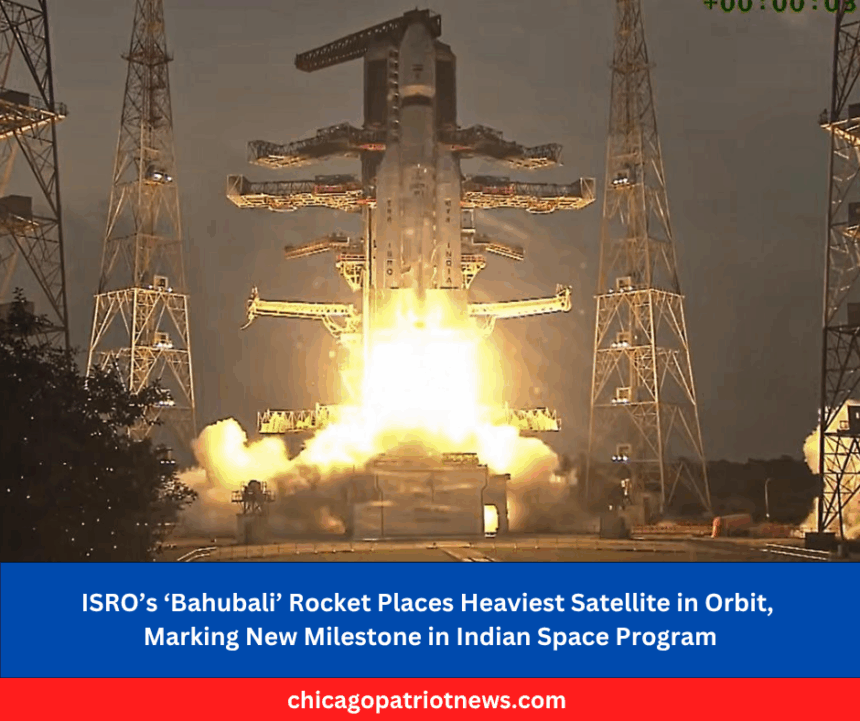
In a landmark achievement for India’s space program, the Indian Space Research Organisation (ISRO) on Sunday successfully launched and placed its heaviest communication satellite, CMS-03, into orbit aboard its powerful LVM3-M5 rocket, nicknamed “Bahubali” for its heavy-lift capability.
The 4,410 kg satellite was injected precisely into a geosynchronous transfer orbit (GTO) from the Satish Dhawan Space Centre, marking another milestone in India’s growing self-reliance in space technology. Designed to provide multi-band communication services across India and adjoining oceanic regions, CMS-03 will replace the decade-old GSAT-7 series and is expected to operate for at least 15 years.
ISRO Chairman V. Narayanan, who also serves as Secretary of the Department of Space, described the launch as “yet another shining example of Atmanirbhar Bharat,” highlighting the mission’s use of fully indigenous technology. Despite challenging weather conditions, scientists ensured a flawless mission, maintaining LVM3’s 100% success rate across all eight launches.
The LVM3—India’s most powerful rocket—features two solid boosters, a liquid core stage, and an advanced C25 cryogenic engine, enabling payloads of up to 4,000 kg in GTO and 8,000 kg in Low Earth Orbit. Previously, ISRO relied on French Ariane rockets from Kourou, but the new vehicle ensures complete autonomy in heavy satellite launches.
Sunday’s mission follows the success of Chandrayaan-3, launched aboard the same rocket in 2023, which made India the first nation to land near the Moon’s south pole. With this achievement, ISRO further cements its position among the world’s top space agencies and strengthens its readiness for the upcoming Gaganyaan human spaceflight program.