

Chicago – November 09, 2025
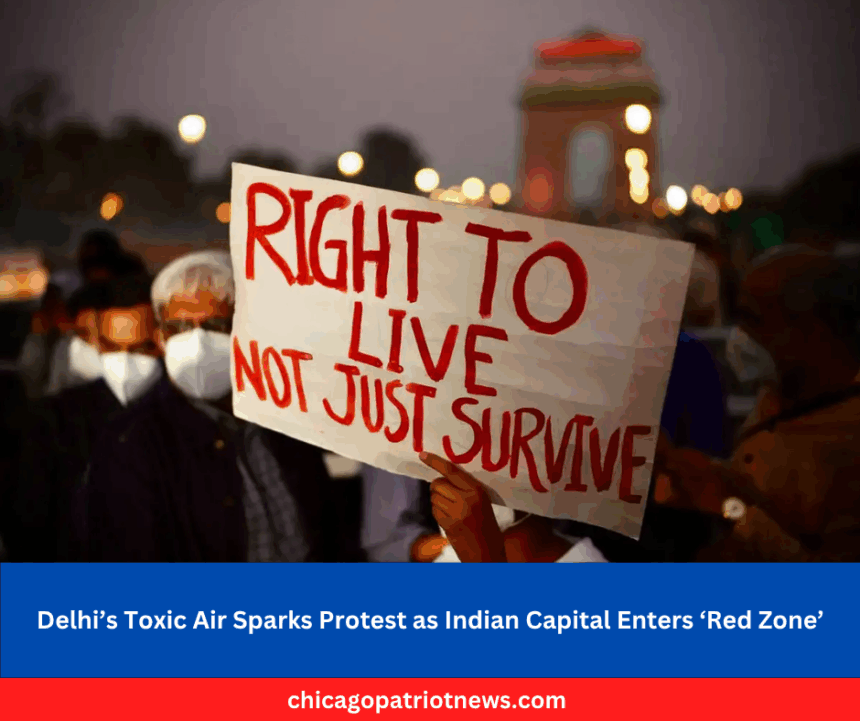
As the Indian Capital Delhi’s air quality plunged into hazardous levels this weekend, parents, children, and environmental activists gathered near India Gate, the 42-meter-high monument, war memorial, popular public space for recreation, a site for protests, and where the Prime Minister pays tribute on Republic Day, on Sunday demanding immediate government action on the capital’s worsening pollution crisis. Police later detained several demonstrators, saying the gathering was held without authorization.
The protest followed a dramatic spike in pollution levels across the city. On Saturday, Delhi’s Air Quality Index (AQI) crossed 400 in multiple neighborhoods — including Wazirpur (420), Burari (418), and Vivek Vihar (411) — pushing the city into the official “red zone.” According to India’s Central Pollution Control Board, particulate matter from vehicle emissions, construction dust, and farm stubble burning has driven PM2.5 and PM10 levels far beyond safe limits. The government has since staggered office hours and ordered the use of anti-smog guns across the city to reduce pollution through February 2026.
At Sunday’s protest, many parents held signs reading “Let Our Kids Breathe,” while mothers voiced anger over children developing respiratory illnesses. Environmentalist Bhavreen Khandari said she had sought an audience with Delhi’s Chief Minister but was denied. “Every third child already has lung damage and could live ten years less than those growing up in cleaner air,” she said.
Police confirmed that several protesters were detained for “preventive reasons,” citing security protocols that limit demonstrations to the designated protest site at Jantar Mantar.
The former party in power Aam Aadmi Party (AAP) backed the protest, accusing the city’s present BJP-led administration of “denying the pollution crisis” and manipulating air quality data. AAP leader Saurabh Bharadwaj described the protest as a spontaneous, non-political response from frustrated citizens who no longer trust official figures.
Delhi’s Environment Minister Manjinder Singh Sirsa, however, defended the administration, saying efforts like anti-smog cannons, e-bus expansion, and construction monitoring were already underway but that “damage caused over a decade can’t be reversed in months.”
Health experts have warned that prolonged exposure to such toxic air can lead to severe respiratory and neurological damage, urging residents to stay indoors, use N95 masks, and avoid outdoor activity until conditions improve. Forecasts show the city’s air will remain “very poor” in the coming days, keeping millions trapped in what locals grimly describe as a winter gas chamber.