

Chicago – December 1, 2025
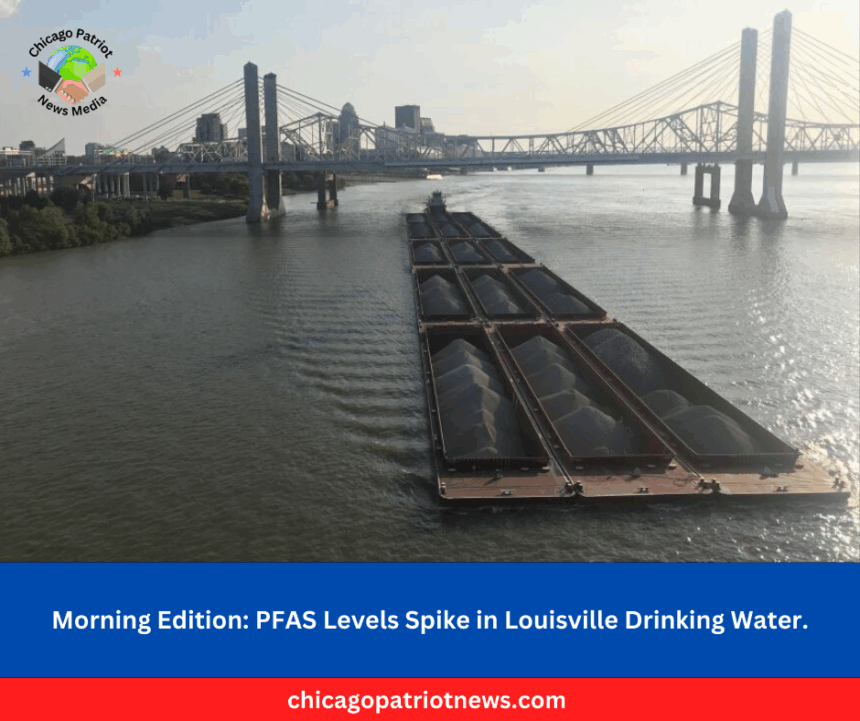
The Ohio River, one of the largest waterways in the U.S., sends billions of gallons of water rushing past Louisville, Kentucky every day. This water is the city’s main source for tap water, treated by utility workers who continually test and filter it for safety. But unlike many smaller utilities across the country, the Louisville Water Company is also monitoring something far more concerning: PFAS chemicals.
PFAS short for per- and polyfluoroalkyl substances have been used for decades in products like nonstick cookware, water-resistant clothing, food packaging, cosmetics, and firefighting foam. They’re extremely durable, earning the nickname “forever chemicals.” They break down so slowly that they’re now found in soil, rivers, drinking water, and even the bloodstream of most Americans.
What Louisville Found in Its Drinking Water
Nearly a year ago, technicians at Louisville’s pumping station noticed something unusual a sharp jump in GenX (HFPO-DA), a type of PFAS that scientists are monitoring closely.
- December PFAS concentration: 52 parts per trillion
- Previous month: 3.4 parts per trillion
- Increase: 15-fold spike in detected levels
Even at such small measurements, the jump sounded an alarm.
A part per trillion is like one second in 32,800 years,” said Peter Goodmann, director of water quality and research.
“Another way to picture it is one drop in 20 Olympic-sized swimming pools.
While Goodmann noted that the levels were still relatively low, the sudden surge shows how unpredictable and widespread PFAS contamination can be even in major water systems.
Why PFAS in Drinking Water Matters
Decades of research have linked PFAS exposure to multiple health risks, including:
Increased cancer risk
High cholesterol
Hormonal and developmental issues in children
Reduced immune function
Unlike contaminants that break down naturally over time, PFAS remain in the environment almost permanently building up in rivers, fish, soil, and eventually, human bodies.
Louisville as a National Example
Many U.S. cities lack the regular screening Louisville performs, which means PFAS may be present but undiscovered in water systems nationwide. Louisville’s monitoring gives scientists valuable insight and makes the city a key indicator in understanding how PFAS spread through U.S. waterways.
The discovery also highlights the value of proactive testing. While the spike did not pose immediate danger, early detection allows researchers to understand pollution trends and prepare for long-term protection of public health.
What Happens Next?
Louisville’s water experts continue to track PFAS levels closely, increasing sample frequency and investing in new detection technologies. Meanwhile, federal regulators are exploring tighter PFAS limits for drinking water, and cities across the U.S. may soon be required to test as Louisville does now.
PFAS contamination is growing, and Louisville’s monitoring could help other cities catch it before levels climb higher.