

Chicago – December 05, 2025
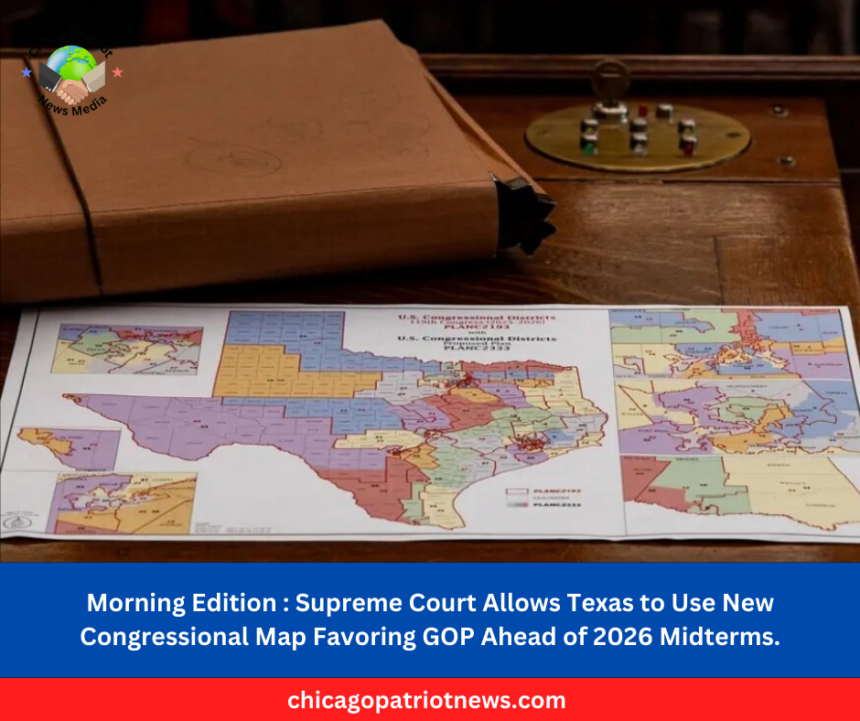
The U.S. Supreme Court has approved Texas’ request to implement a newly drawn congressional map that could give Republicans up to five additional House seats in the 2026 midterm elections. The ruling marks a significant win for the GOP as it fights to maintain its narrow majority in the House.
The unsigned order, released Thursday, comes amid an escalating national gerrymandering battle fueled in part by President Trump, who has urged Republican-led states to redraw congressional boundaries to strengthen GOP advantages.
Lower Court Found Racial Bias Likely
The Supreme Court’s decision halts a ruling made by a three-judge federal panel that blocked the new map after a nine-day hearing in October. That panel concluded challengers were likely to prove the map violates the U.S. Constitution by intentionally discriminating against minority voters.
In its majority opinion written by a judge appointed by Trump the panel cited evidence including a Department of Justice letter and multiple public remarks by senior Republican lawmakers. These statements suggested that map-drawers manipulated racial demographics to dismantle districts where Black and Latino voters previously formed a combined majority.
As a result, the panel ordered Texas to continue using the 2021 congressional districts during the upcoming election cycle.
Texas Argues Politics, Not Race, Drove the Redraw
Texas appealed to the Supreme Court, insisting that lawmakers did not consider race when redrawing the districts. The state argued that the updated map simply aimed to create more Republican-leaning seats, not to suppress minority voting power.
What the Ruling Means for 2026
With the Supreme Court’s intervention, Texas is now free to use the disputed map for next year’s elections potentially reshaping the political landscape and giving the GOP a crucial edge in its fight to retain control of the House.
The ruling also intensifies the broader legal and political debate over redistricting tactics and the boundaries of partisan power, a dispute likely to continue well into the 2026 election cycle.