

Chicago – May 03, 2025
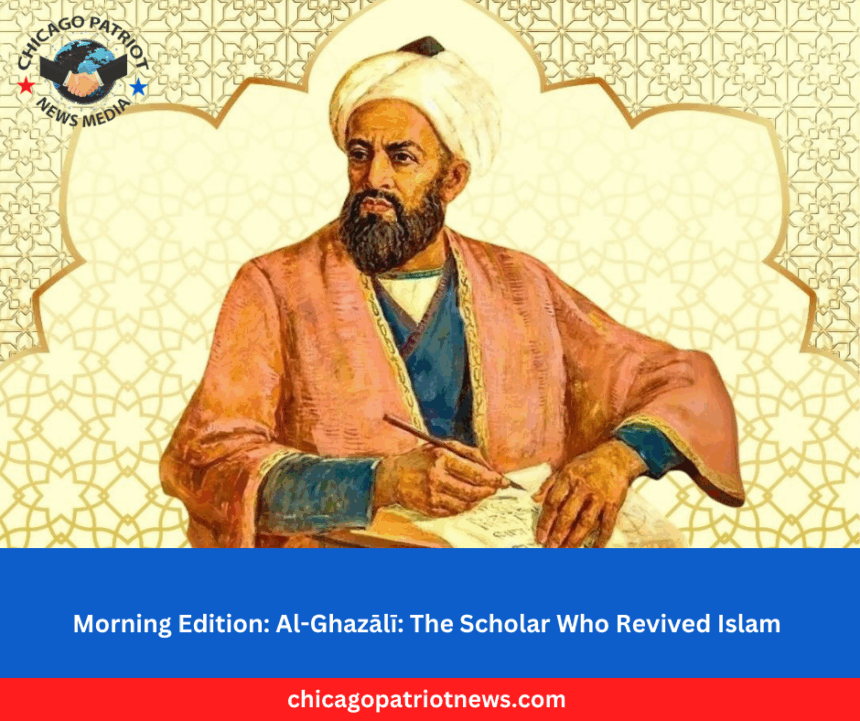
Al-Ghazālī was a Muslim scholar and mystic born in 1058 in Ṭūs, Iran, and he died there on December 18, 1111. He is most famous for his book Iḥyāʾ ʿulūm al-dīn (“The Revival of the Religious Sciences”), which helped make Sufism, or Islamic mysticism, a respected part of mainstream Islam.
He studied in several cities, including Ṭūs, Jorjān, and Nishapur, where he learned from the well-known teacher al-Juwaynī. After al-Juwaynī’s death in 1085, al-Ghazālī was invited to the court of Niẓām al-Mulk, a powerful Seljuq vizier. Impressed by al-Ghazālī’s knowledge, the vizier made him the chief professor at the Niẓāmiyyah college in Baghdad in 1091. While teaching over 300 students, al-Ghazālī also studied and criticized the ideas of earlier Muslim philosophers like al-Fārābī and Avicenna.
However, he went through a deep spiritual crisis that made him unable to continue teaching. In 1095, he left Baghdad, saying he was going on a pilgrimage to Mecca, but he actually began living as a poor Sufi. He spent time in Damascus and Jerusalem and did eventually visit Mecca in 1096. Later, he returned to his hometown of Ṭūs and lived there in a simple, spiritual community with other Sufis.
In 1106, he went back to teaching at the Niẓāmiyyah college in Nishapur. His return was partly encouraged by the idea that a religious “reviver” was expected at the start of each Islamic century, and some believed al-Ghazālī was that figure for the new century beginning in 1106. He taught there until around 1110, after which he went back to Ṭūs, where he passed away the next year.
Although over 400 writings are credited to him, many of these are duplicates under different titles or works that may not be his. Still, about 50 of his writings are known to be authentic and still exist today.