

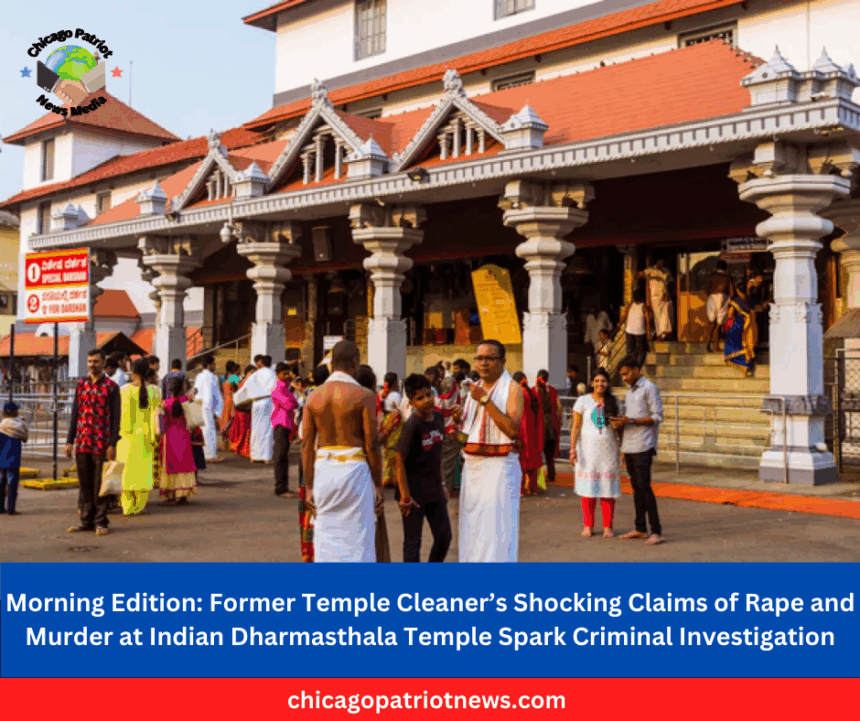
Chicago – August 24, 2025
In early July, a middle-aged man filed a police complaint and appeared before a magistrate to give a statement, making shocking claims about his time working as a cleaner at a temple in southern India. The man’s identity has been kept confidential, and he has been seen in public wearing all-black attire, including a hood and face mask.
According to the complaint, the man worked at the temple from 1995 to 2014. He alleged that he had been forced to bury the bodies of hundreds of girls and young women, who were brutally raped and murdered. He provided specific details of five such incidents and suggested there were many more, some involving minors. He claimed to have been in hiding since 2014, only returning recently to speak out due to the weight of his conscience.
While the cleaner did not name any individuals, he placed blame on the “temple administration and its staff.” The temple’s chief rejected these accusations, calling them “false and baseless.”
In a dramatic twist, the man produced a human skull during his court appearance, claiming it belonged to one of the victims he had buried. He said he had recently retrieved it from the burial site as evidence.
The allegations quickly gained widespread media attention, prompting the state’s women’s commission to raise concerns. In response, the government initiated a criminal investigation and formed a Special Investigation Team (SIT) to probe the claims.
Over the past few weeks, the SIT has conducted excavations at several locations in and around the temple town of Dharmasthala, based on the man’s directions. He initially identified 13 sites, some in remote and dangerous areas, reportedly infested with venomous snakes.
According to SIT sources, human remains, including a skull and around 100 bone fragments, have been uncovered at two of these sites and sent for forensic analysis. It is still unclear to whom the remains belong.
Following the claims, the man was arrested by police. There have been repeated protests over the years regarding the discovery of bodies of rape-and-murder victims in and around Dharmasthala, dating back to the 1980s.