

Chicago – December 18, 2025
In May, President Donald Trump welcomed executives from America’s nuclear power industry to the Oval Office, praising the sector as a rapidly growing and strategically important part of the U.S. energy landscape. Calling nuclear power a “hot” and “brilliant” industry, Trump highlighted its potential to deliver reliable energy at scale as billions of dollars flow into new nuclear technologies.
The meeting underscored a renewed push by the Trump administration to accelerate nuclear power development, particularly through next-generation reactor designs that promise safer, cheaper, and more flexible energy production.
Small Modular Reactors Gain Momentum
At the center of this nuclear revival are small modular reactors (SMRs), compact designs that can be mass-produced and deployed in large numbers. Supporters argue that these reactors could transform the energy sector by providing consistent, carbon-free power while reducing construction costs and timelines.
However, industry leaders say regulatory hurdles remain a major obstacle. Joseph Dominguez, CEO of Constellation Energy which operates roughly one-quarter of America’s existing nuclear reactors warned that delays in permitting and safety reviews threaten the economic viability of new nuclear plants.
“Delay in regulations and permitting will absolutely kill you,” Dominguez told the president, emphasizing that stalled projects mean delayed revenue and rising costs.
New Program Sidesteps Traditional Nuclear Oversight
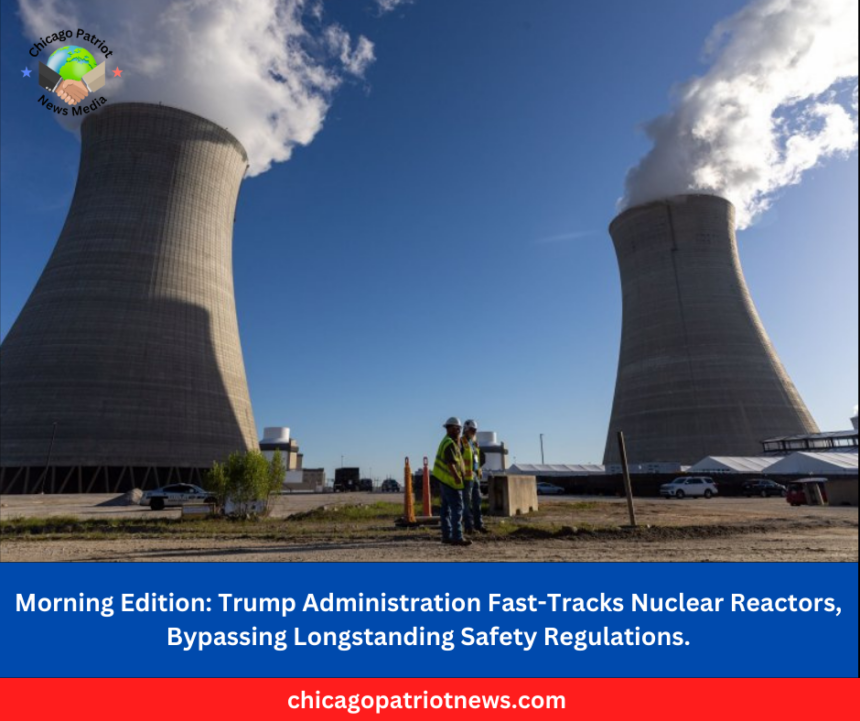
In response, the Trump administration has launched a new Reactor Pilot Program aimed at accelerating nuclear innovation by bypassing parts of the regulatory system that has governed the industry for over 50 years. The program seeks to fast-track the construction of new and untested reactor designs developed by private companies.
The stated goal is ambitious: to have at least three nuclear test reactors operational by July 4, 2026, coinciding with the United States’ 250th anniversary.
Reduced Role for the Nuclear Regulatory Commission
Traditionally, the Nuclear Regulatory Commission (NRC) has been responsible for overseeing the safety of commercial nuclear reactors since the 1970s. Under the new program, however, the NRC will serve only in a consulting role.
Instead, the Department of Energy’s Office of Nuclear Energy will oversee the Reactor Pilot Program, marking a significant shift in how nuclear safety and approval processes are handled in the United States.
Support and Concerns Surround the Initiative
Proponents argue that cutting red tape is essential for maintaining U.S. leadership in nuclear technology and meeting future energy demands. They say the fast-track approach could help America compete with countries like China and Russia, which are rapidly expanding their nuclear capabilities.
Critics, however, warn that sidelining the NRC could raise serious safety concerns, particularly when dealing with untested reactor designs. As the administration moves forward, the balance between innovation, speed, and safety is likely to remain a central point of debate.
The Reactor Pilot Program represents one of the most significant changes to U.S. nuclear policy in decades one that could reshape the future of American energy production.