
Chicago – November 10, 2025
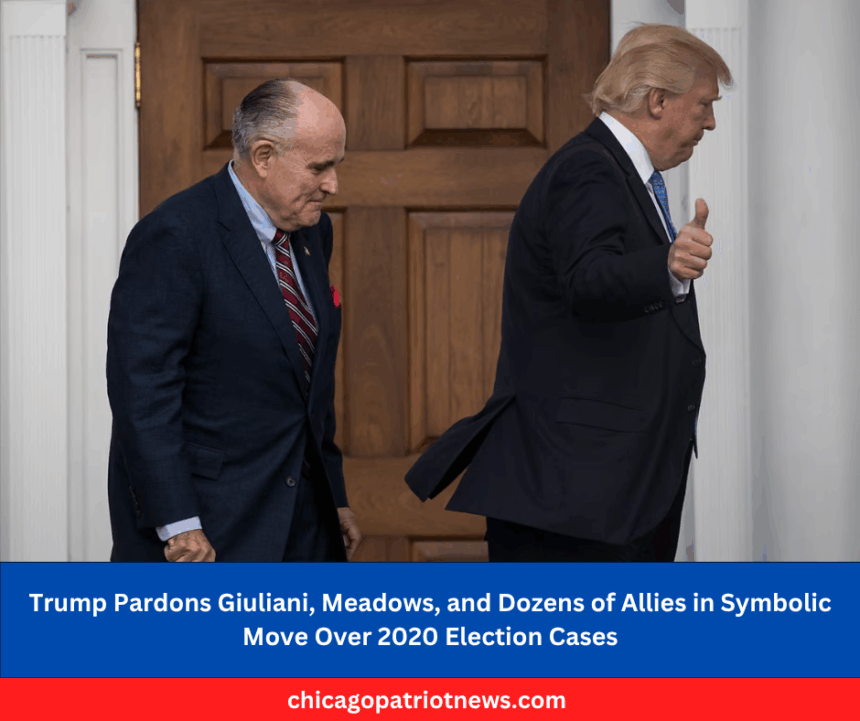
In one of his most controversial acts since returning to the White House, President Donald Trump has issued sweeping federal pardons for Rudy Giuliani, Mark Meadows, Sidney Powell, Jenna Ellis, and more than 70 others accused of attempting to overturn the 2020 presidential election.
The White House called the pardons part of a “process of national reconciliation,” framing the prosecutions as politically motivated. “Getting prosecuted for challenging results is something that happens in communist Venezuela, not the United States,” said press secretary Karoline Leavitt, adding that Trump was “putting an end to the Biden regime’s communist tactics once and for all.”
Trump’s proclamation, posted by Justice Department attorney Ed Martin, described the pardons as “full, complete, and unconditional.” It declared an intent to “end a grave national injustice” and restore fairness to those “persecuted for defending democracy.” However, the move is largely symbolic, as the pardons only apply to federal charges, while nearly all the recipients face state-level prosecutions in Georgia, Arizona, Michigan, Wisconsin, and Nevada.
Among those pardoned were lawyers who had crafted the failed legal challenges to Joe Biden’s 2020 victory — including Sidney Powell, who promoted baseless claims about voting machines switching votes, and John Eastman and Kenneth Chesebro, who designed the fake electors strategy. Former Chief of Staff Mark Meadows was also pardoned, despite still facing state-level indictments in Arizona.
Rudy Giuliani, Trump’s onetime personal attorney and one of the most prominent figures in the effort to reverse the 2020 results, was also granted clemency. Giuliani was disbarred in New York and Washington, D.C., and ordered to pay nearly $150 million to two Georgia election workers he falsely accused of vote rigging. He remains entangled in ongoing defamation cases involving Dominion and Smartmatic.
The list of pardons also includes Jeffrey Clark, Christina Bobb, Boris Epshteyn, and several of the so-called “false electors” who were accused of submitting fake certificates declaring Trump the winner in battleground states.
Trump’s proclamation notably did not include himself, though he has repeatedly claimed he has the constitutional power to pardon his own conduct — a move that legal experts say would face immediate court challenges.
The announcement continues Trump’s broader campaign to reframe the fallout of the 2020 election as a “witch hunt.” On his first day back in office in January, he granted clemency to over 1,500 supporters convicted in connection with the January 6 Capitol riot.
Legal experts have called the latest round of pardons “symbolic theater”, as most of the prosecutions remain outside federal jurisdiction. Still, the move sends a clear political message: Trump intends to rewrite the post-2020 narrative — absolving his allies while casting the investigations as a betrayal of democratic freedom.