
Chicago – December 18, 2025
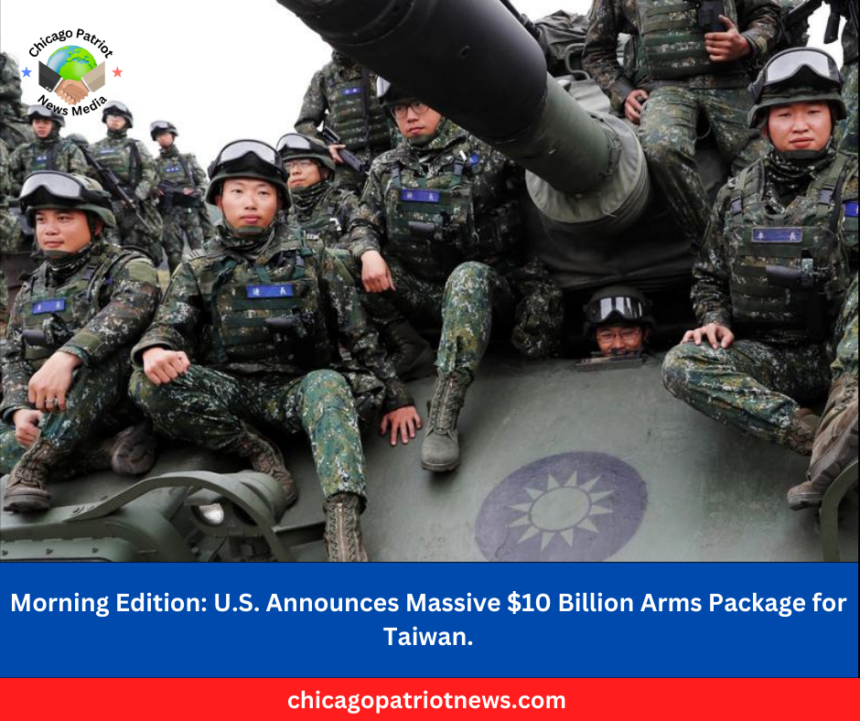
The Trump administration has approved a major arms sales package to Taiwan worth more than $10 billion, a move expected to significantly heighten tensions with China. The announcement, made by the U.S. State Department late Wednesday, includes advanced missiles, artillery systems, drones, and military software aimed at strengthening Taiwan’s defensive capabilities.
The announcement came during a nationally televised address by President Donald Trump, though the president did not mention China, Taiwan, or foreign policy matters in his speech. Despite this, the arms deal underscores Washington’s continued commitment to Taiwan’s security amid growing concerns over Beijing’s military posture in the region.
What the Arms Deal Includes
The package consists of eight separate arms sales agreements. Among the most significant items are 82 High-Mobility Artillery Rocket Systems (HIMARS) and 420 Army Tactical Missile Systems (ATACMS), valued at over $4 billion. These systems are similar to weapons previously supplied by the United States to Ukraine for its defense against Russia.
In addition, the U.S. approved the sale of 60 self-propelled howitzer systems and related equipment worth more than $4 billion. The deal also includes drones valued at over $1 billion, along with military software exceeding $1 billion in value.
Other components of the package include Javelin and TOW anti-tank missiles worth more than $700 million, helicopter spare parts valued at $96 million, and refurbishment kits for Harpoon missiles totaling $91 million.
U.S. Justification and Legal Obligations
In nearly identical statements, the State Department said the arms sales support “U.S. national, economic, and security interests” by helping Taiwan modernize its armed forces and maintain a credible defensive capability. The department emphasized that the sales would contribute to political stability, military balance, and economic progress in the Indo-Pacific region.
Under U.S. federal law, Washington is obligated to assist Taiwan in maintaining its self-defense capabilities. This commitment has long been a point of contention with China, which considers Taiwan a breakaway province and has vowed to reunify it with the mainland, by force if necessary.
Taiwan Welcomes the Decision
Taiwan’s Ministry of National Defense welcomed the arms sales, expressing gratitude to the United States. In a statement released Thursday, the ministry said the package would help Taiwan maintain “sufficient self-defense capabilities” and significantly enhance its deterrence posture.
The ministry added that strengthening Taiwan’s defense is essential for preserving regional peace and stability, particularly amid rising military pressure from China.
Regional Implications
The arms deal comes at a time of fluctuating U.S.-China relations during Trump’s second term, marked by ongoing trade disputes, tariffs, and increasing Chinese military activity around Taiwan. While the sales are framed as defensive, they are likely to provoke a strong response from Beijing, further complicating relations between the world’s two largest economies.
As tensions continue to rise in the Asia-Pacific, the latest U.S. arms sales to Taiwan highlight Washington’s strategic priorities and its commitment to countering China’s growing influence in the region.