

Chicago – December 11, 2025
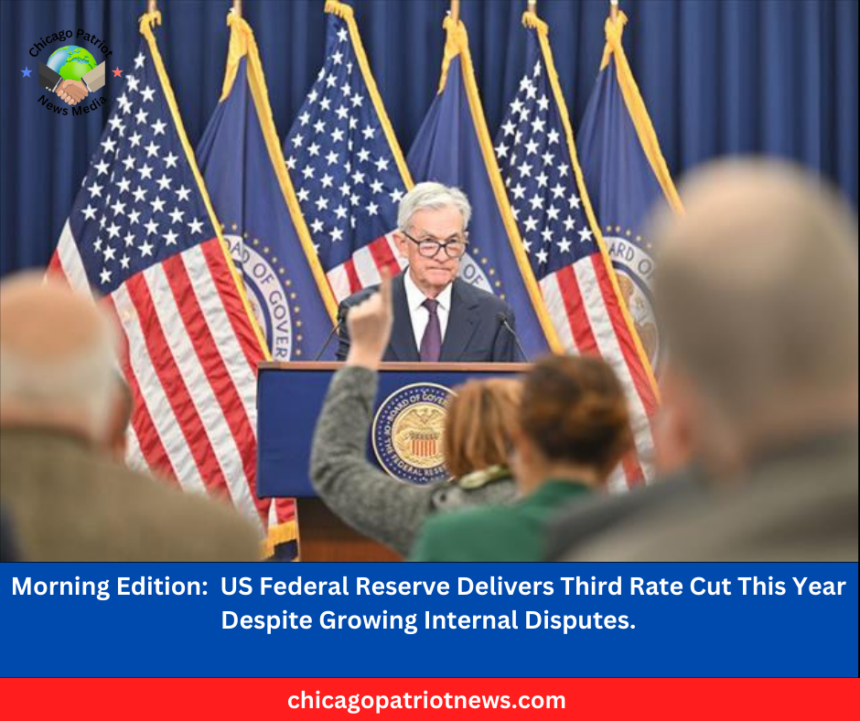
The US Federal Reserve has reduced interest rates for the third time in 2025, even as disagreements among policymakers create uncertainty over whether more cuts are coming. The central bank announced on Wednesday that it would lower its benchmark lending rate by 0.25 percentage points, setting it between 3.50% and 3.75%, the lowest level seen in three years.
Fed Officials Split on How to Handle Inflation vs. Jobs
The decision reflects an intensifying debate inside the Fed over how to manage two competing threats: a softening labour market and persistent inflation. According to newly released economic projections, policymakers anticipate one additional rate cut next year, though shifting data could easily alter that outlook.
Fed Chair Jerome Powell stressed that the central bank needs time to measure the full impact of this year’s trio of rate cuts. Speaking to reporters, Powell said officials will rely heavily on new economic data ahead of their next meeting in January.
Three Fed Officials Break from Consensus
The vote to lower rates was far from unified. Three Fed officials dissented, revealing widening divides about the future direction of monetary policy.
- Stephen Miran, currently on leave from the White House Council of Economic Advisers, pushed for a sharper 0.5-point cut.
- Austan Goolsbee, head of the Chicago Fed, and Jeffrey Schmid from the Kansas City Fed voted to keep rates unchanged.
President Donald Trump, who has consistently urged for more rapid reductions, criticised the move as insufficient, saying the cut “could have been at least doubled.”
Economic Uncertainty Complicates Rate Strategy
Policymakers are still dealing with gaps in economic data following the record-long government shutdown that ended in November, which left officials without key indicators for months. Despite this uncertainty, signs of labour market weakness continue to dominate discussions.
The unemployment rate rose from 4.3% to 4.4% in September, according to delayed Labour Department figures. Lowering interest rates is intended to support hiring by reducing borrowing costs for businesses.
Inflation, however, remains above the Fed’s preferred 2% target. It climbed to 3% in September, driven in part by the lingering effects of tariffs on consumer prices. Still, milder inflation numbers in recent months have given the Fed more flexibility to prioritise stabilising employment.
Analysts Expect More Cuts in 2025
Financial analysts say the central bank’s challenge is navigating high inflation while responding to political and economic pressure for looser monetary policy. Colleen McHugh, consultant for investment platform Wealthify, said that elevated inflation complicates the Fed’s decisions, but the weakening jobs data appears to have pushed them toward another cut.
McHugh predicts one or two more reductions next year, noting the political spotlight on Powell and the Federal Open Market Committee.