

Chicago – November 13, 2025
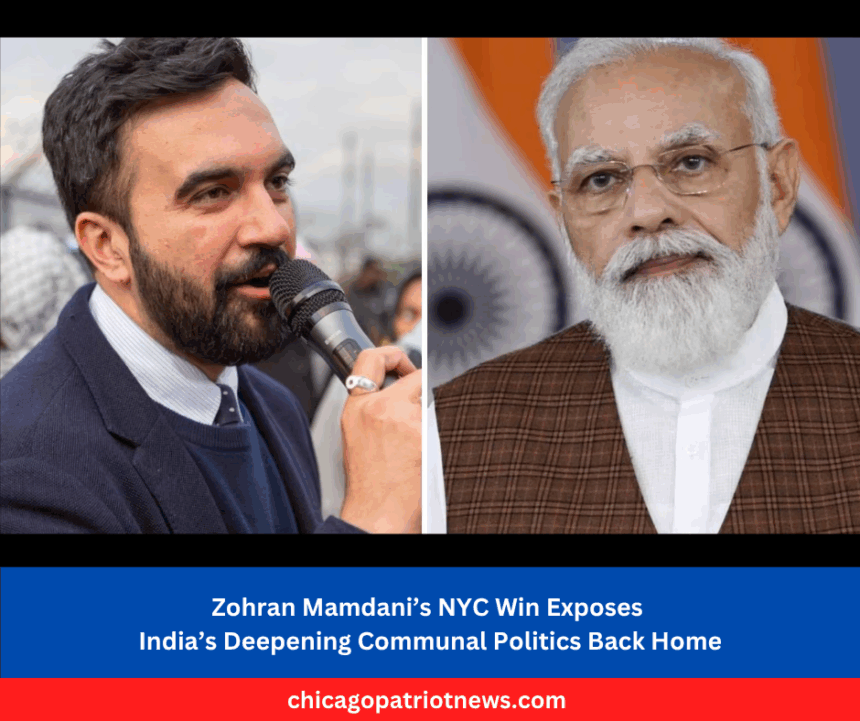
When Zohran Mamdani, a 34-year-old Indian-origin Muslim democratic socialist, won the New York City mayoral race last week, the celebrations in parts of India were matched instantly by a familiar strain of anxiety and communal rhetoric. What should have been a moment of diaspora pride, the son of filmmaker Mira Nair becoming the first Muslim and South Asian mayor of America’s largest city, instead opened yet another front in India’s increasingly polarised public sphere.
From New York to Mumbai: The First Flashpoint
Soon after Mamdani’s victory, Mumbai BJP chief Ameet Satam issued a startling warning: “If anyone tries to impose a Khan on Mumbai, it will not be tolerated.” His remarks, which he doubled down on by alleging a so-called vote jihad in the city, were widely criticised by opposition parties. The comments reflected a political environment where Muslim identity itself is increasingly treated as a threat.
This was not an isolated comment. It was the language of a political ecosystem in which every development, even one happening 12,500 kilometres away, becomes fodder in the battle over religious identity.
Why a New York Mayor Triggered Indian Politics
Mamdani’s own politics are openly left-wing, anti-Islamophobia and sharply critical of Prime Minister Narendra Modi, the BJP and the RSS. He has repeatedly described India under Modi as a place where “only certain kinds of Indians” belong, and has gone so far as to call Modi “fascist” and responsible for anti-Muslim violence. His views have long drawn anger from BJP-linked groups in the United States, and Indian politicians were quick to react the moment he won.
Shashi Tharoor congratulated Mamdani and his mother Mira Nair. Congress spokesperson Supriya Shrinate hailed Mamdani’s invocation of Nehru’s “Tryst with Destiny” speech and said that Nehru’s legacy continues to echo across oceans. Trinamool MP Mahua Moitra celebrated the win as proof that love and courage still triumph.
The reactions revealed something deeper. Mamdani’s election in the United States had become a symbolic battleground for India’s own ideological conflict.
India’s Communal Climate: A Wider Pattern
Satam’s comments fit into a broader pattern of majoritarian rhetoric that has grown more explicit in recent years. Open anti-Muslim messaging has become a recurring feature of local and national election campaigns. Public calls to boycott Muslim businesses have been amplified in several states. Communal flare-ups are often used as political flashpoints. Muslim political representation has shrunk sharply, with only 25 Muslim MPs elected in the 2024 Lok Sabha polls, which is the lowest in independent India. Urban politics has become heavily polarised, where issues such as housing societies, food bans or hijab restrictions are turned into communal debates. Rhetoric around vote jihad, land jihad or love jihad has found its way into mainstream political vocabulary.
In this environment, Mamdani, who is young, Muslim, outspoken and socialist, became an instant lightning rod.
The BJP’s Tone and the Opposing Voices
The BJP’s reaction was not limited to Satam. Party MP Kangana Ranaut accused Mamdani of “sounding more Pakistani than Indian.” Opposition parties countered by highlighting Mamdani’s message of pluralism, especially his quoting of Nehru.
The divide reflected India’s internal fault lines. It was a contest between an inclusive vision of India and a majoritarian one.
Why Mamdani’s Comments Hit a Nerve
Mamdani has previously criticised the BJP for the Babri Masjid demolition, the Gujarat riots and anti-Muslim policies. He once posted a photo of Babri Masjid, calling its destruction an atrocity instigated by the BJP. He described large-scale violence against Muslims in Gujarat as something Modi “helped orchestrate.”
These views, which are highly contested in India, become ammunition during an election season where religious symbolism is heavily mobilised.
To many BJP supporters, Mamdani represents what they describe as anti-Hindu and anti-India politics. To many opposition supporters, he symbolises the pluralist India they fear is disappearing.
Cross-Continental Politics: Trump vs Mamdani
Mamdani entered office with a direct challenge to Donald Trump, who fired back with a terse “And so it begins” on Truth Social.
Trump’s hostility paradoxically elevated Mamdani’s image among Indian liberals who see parallels between Trump’s politics and what they believe Modi represents.
The metaphors became impossible to ignore. Many began to see the dynamic of Modi versus Mamdani, Trump versus Mamdani, ideology versus identity, and India versus diaspora India.
What Mamdani’s Win Reveals About India Today
The intensity of India’s reaction shows how deeply communal polarisation has shaped political discourse. Even an American mayoral result becomes a proxy war over religion, nationalism and ideological identity.
It highlights several trends that are becoming increasingly clear.
India’s political conversation now extends globally. Every diaspora figure is pulled into domestic culture wars. Communal anxieties dominate political and social debates, and symbolic victories by Muslims abroad provoke defensive messaging at home. The long-standing ideological battle between Nehru’s pluralism and today’s majoritarian nationalism continues to shape public reactions. Opposition parties view diaspora liberals as ideological allies, while the ruling party treats them as adversaries. Muslim identity has become politicised regardless of geography, occupation or nationality.
A Victory in New York, a Mirror to India
Mamdani’s win was about New York’s cost-of-living crisis, public transit and an anti-establishment campaign. In India, however, it was interpreted through the lens of religion, loyalty and ideological identity, markers that now dominate public life.
His victory speech’s invocation of Nehru resonated with many Indians who still see Nehru’s pluralist ideals as central to India’s past and perhaps its future. It also provoked those who believe that India’s future lies in majoritarian assertiveness.
In the end, the story of Zohran Mamdani’s triumph in New York is not just about a mayoral election. It is a spotlight on how deeply communal polarisation shapes political reactions in India today and how global events are instantly refracted through that divide.