

Chicago – November 05, 2025
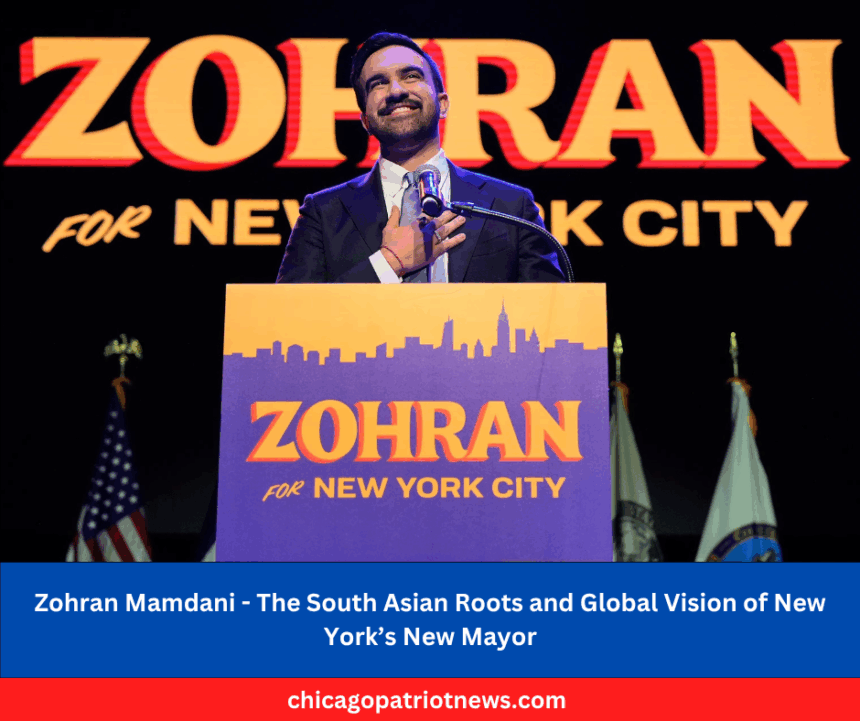
Zohran Kwame Mamdani’s decisive victory in the 2025 New York City mayoral election marks a generational shift in the city’s politics and identity. After defeating former governor Andrew Cuomo in the Democratic primary earlier this year, Mamdani built a movement rooted in grassroots organizing, small donations, and strong support from young and working-class New Yorkers. Reports in The Guardian and the New York Post described his campaign as people-driven and unapologetically progressive, focused on housing, workers’ rights, and equity. His win makes him New York’s first Muslim and South Asian mayor, as well as its youngest leader in over a century.
Those who know Mamdani credit his family with shaping his political ideals. He grew up in a home where activism, academia, and art were intertwined. His father’s deep engagement with postcolonial theory and his mother’s storytelling through film helped him see how issues of race, migration, and justice connect across continents. That awareness became the backbone of his political vision for an inclusive New York that, as he said in his victory speech, “belongs to everyone who builds it, not just those who can buy it.”
Born on October 18, 1991, in Kampala, Uganda, Mamdani’s early life was marked by movement and multiculturalism. His parents, both of Indian origin, relocated from East Africa to South Africa before settling in New York when he was a child. His middle name, Kwame, was chosen by his father to honor Ghanaian leader Kwame Nkrumah, reflecting Pan-African influences within the family. Mamdani attended public schools in New York and later graduated from the Bronx High School of Science before earning a degree in Africana Studies from Bowdoin College in 2014.
His South Asian roots remain an important part of his identity and political voice. The Mamdani family traces its ancestry to India, with his father’s family hailing from Gujarat and his mother’s from Punjab. Despite growing up in the United States, Mamdani has often spoken about India as a cultural and emotional homeland. During his campaign, he frequently referenced his Indian heritage when discussing global democracy, expressing concern about rising religious polarization under Prime Minister Narendra Modi and the BJP. In his victory speech, he reiterated his belief that India’s strength lies in its diversity, not division, and that any vision of India that excludes its minorities is a betrayal of its own freedom struggle. His message resonated strongly among the South Asian diaspora in New York, many of whom see him as a symbol of secular, pluralistic values.
His father, Mahmood Mamdani, is one of Africa’s most respected intellectuals. Born in Mumbai and raised in Uganda, he experienced the trauma of Idi Amin’s 1972 expulsion of Asians, which forced his family into exile. Educated at the University of Pittsburgh and Harvard, he went on to become a globally recognized scholar of African politics and postcolonial governance. Now the Herbert Lehman Professor of Government at Columbia University, his influential works such as Citizen and Subject and Good Muslim, Bad Muslim examine power, identity, and history in the global South. Those themes—decolonization, equity, and human dignity—echo in his son’s politics.
Mamdani’s mother, Mira Nair, is an internationally celebrated filmmaker whose works, including Salaam Bombay!, Monsoon Wedding, The Namesake, and Queen of Katwe, have explored themes of migration, identity, and belonging. Born in Rourkela, India, and educated at Delhi University and Harvard, Nair has built bridges between India, Africa, and the West through her art. Her Kampala-based Maisha Film Lab nurtures East African filmmakers, promoting local storytelling traditions. Growing up around her work, Zohran absorbed the idea that narratives can challenge injustice and build empathy.
Both parents embody the crosscurrents of displacement and creativity that define the Indian diaspora in Africa and the West. Their experiences of migration, exclusion, and resilience shaped Zohran’s worldview. His politics carry the same transnational consciousness—rooted in India’s secular heritage, Africa’s struggle against colonialism, and New York’s tradition of immigrant inclusion.
Before entering politics, Mamdani worked as a housing counselor and community organizer in Queens, confronting systemic inequalities that became central to his campaign message. His early career grounded him in the daily struggles of ordinary New Yorkers, reinforcing his commitment to justice through practical change.
In his election night speech, Mamdani described his victory as “a continuation of stories told long before me,” linking his personal journey to that of his parents and immigrant communities everywhere. His rise from Kampala to City Hall symbolizes the crossing of boundaries—geographic, cultural, and political—that define New York itself. For the city’s vast South Asian diaspora, his win represents not just a political milestone but a cultural affirmation: a reminder that inclusion, solidarity, and moral courage can still define leadership in the world’s most diverse metropolis.
Mamdani’s story is one of inheritance and reinvention, drawing from the intellectual rigor of his father, the artistic humanity of his mother, and the pluralistic ideals of his heritage. As he begins his tenure as mayor, his life stands as a testament to how the intertwined histories of India, Africa, and America can converge in a single individual—and how that convergence can help reshape the future of a city built by the world.