

Chicago – November 20, 2025
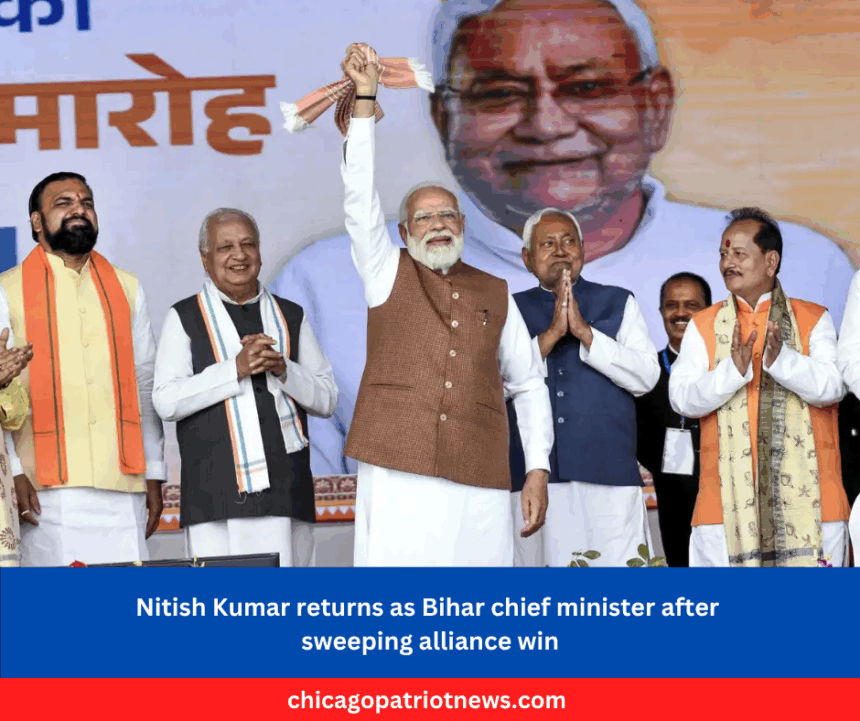
Nitish Kumar has taken office as chief minister of Bihar once again, days after his party and its allies delivered a commanding victory in one of India’s most closely watched state elections. The Janata Dal (United) leader, backed by Prime Minister Narendra Modi’s Bharatiya Janata Party, now begins his tenth term at the helm of a state that has shaped his political career for two decades.
The alliance won 202 of 243 seats, a margin that surprised even some within the coalition. The result followed weeks of debate over a revision of voter lists that opposition parties said would sideline genuine voters and tilt the race in favour of the BJP. Both the Election Commission and the ruling parties rejected that allegation, calling the process routine.
Kumar was sworn in before a large gathering in Patna, a day after legislators formally elected him as their leader. At 74, he remains one of Bihar’s most durable political figures, having governed the state almost continuously since 2005 apart from a short break.
The election saw record participation, with turnout reaching nearly 67 percent, the highest since independence-era polling in 1951. Women voted in larger numbers than men, continuing a trend that has reshaped Bihar’s political calculations. Modi praised the verdict as “a victory for democracy” and said it reflected public confidence in the alliance.
The BJP won 89 seats, while Kumar’s party secured 85. Smaller allies made up the remaining strength that pushed the bloc past the two-thirds mark. Their main challengers, a coalition of the Congress party, the Rashtriya Janata Dal and smaller regional groups, finished with only 35 seats.
The stakes of the Bihar election extended beyond the state. It was the last major contest before national-level battles in West Bengal, Kerala and Tamil Nadu next year, where the BJP is still trying to expand its presence. Analysts say the emphatic result will strengthen the BJP-JD(U) partnership as the ruling coalition prepares for a broader political season.
For Bihar, the outcome keeps the state’s political structure unchanged but underscores how central Kumar remains to local governance. His return signals continuity in a region marked by high migration, persistent economic challenges and long-running debates about development and welfare.
Kumar’s new term begins under intense scrutiny, but for now the landslide victory has reinforced his position as one of the few leaders outside the BJP who can deliver a decisive mandate while remaining firmly aligned with Modi’s national coalition.