
Chicago – December 10, 2025
As Israel and Hamas prepare to enter the second phase of a United States-led plan aimed at ending Israel’s war on Gaza, major disagreements have surfaced regarding the future role of an international stabilisation force inside the enclave.
Senior Hamas official Basem Naim said on Sunday that the current US proposal still lacks clarity. While Hamas is open to discussing the “freezing or storing” of its weapons during the truce, the group firmly rejects the idea of any international force handling disarmament within Gaza.
Naim explained that Hamas would accept a United Nations peacekeeping force positioned near Gaza’s borders to monitor the ceasefire, report violations, and help prevent escalation. However, he stressed that Hamas will not allow a foreign force to exercise authority or enforce mandates on Palestinian land.
His remarks followed comments by Israeli Prime Minister Benjamin Netanyahu, who announced he would meet with US President Donald Trump later this month to discuss advancing to phase two of the American proposal. Netanyahu said the main goal of the upcoming phase is to eliminate Hamas’s governance in Gaza and ensure that the organisation complies with disarmament requirements laid out in the plan.
“We have a second phase, no less daunting, and that is to achieve the disarmament of Hamas and the demilitarisation of Gaza,” Netanyahu stated during a joint press briefing with visiting German Chancellor Friedrich Merz.
It remains unclear whether Hamas’s willingness to freeze or store its weapons rather than surrendering them will be enough to satisfy Israel’s demand for full demilitarisation. Naim reaffirmed that the group maintains its “right to resist,” and indicated that any surrendering of arms would only be possible as part of a broader political process leading toward an independent Palestinian state. He added that a long-term truce lasting five to ten years could be considered under such circumstances.
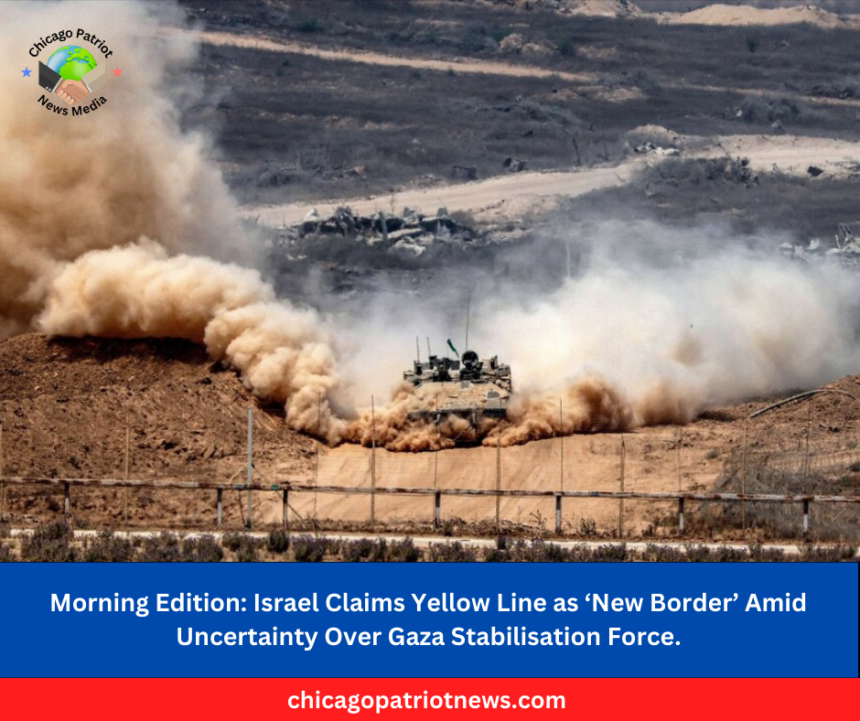
As Israel marks a yellow line that it calls Gaza’s “new border,” questions persist about how a stabilisation force will operate and what authority, if any, it will have. With both sides standing firm on critical issues, the path toward implementing the next phase of the US-led plan remains fraught with uncertainty.