

Chicago – December 24, 2025
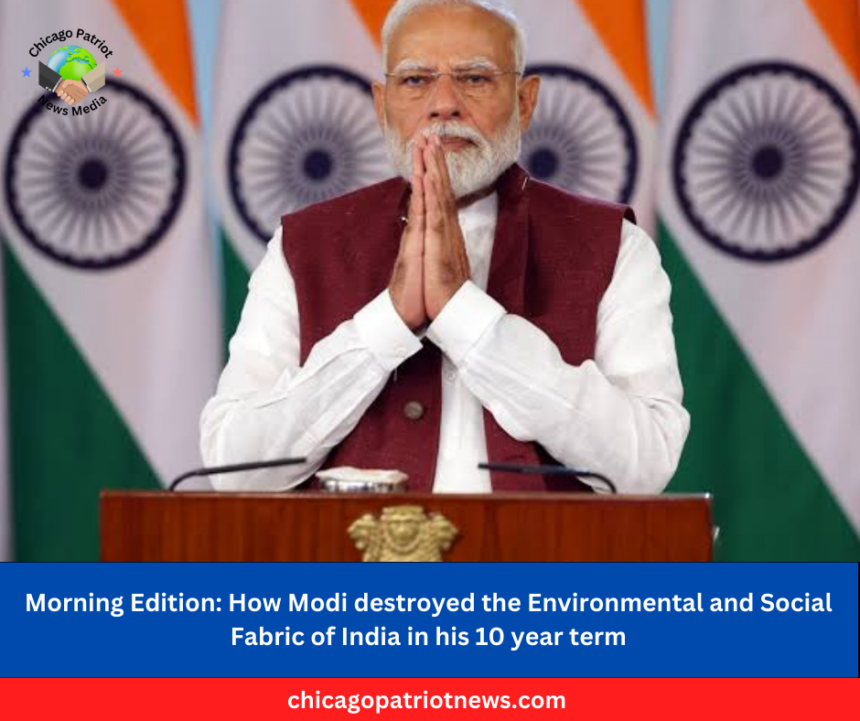
Since coming to power in 2014, Prime Minister Narendra Modi and the Bharatiya Janata Party (BJP) have reshaped India’s political, environmental, and social landscape. While supporters credit the government with economic reforms and strong leadership, critics argue that these years have also seen severe damage to India’s air and water quality, reckless exploitation of natural resources like sand, erosion of constitutional values, and growing discrimination against non-Hindu communities. Together, these trends raise serious concerns about the future of India’s democracy and ecological survival.
1. Deteriorating Air Quality: Growth Over Health
India now dominates global rankings for the world’s most polluted cities. During the Modi years, air quality in urban centers such as Delhi, Lucknow, and Kanpur has worsened dramatically. Critics argue that the government’s emphasis on rapid industrial growth, highway expansion, and construction has come at the cost of public health.
Environmental regulations have been diluted to speed up “ease of doing business,” and enforcement agencies remain weak. While symbolic initiatives—such as promoting clean cooking gas or electric mobility—have been announced, they have failed to counter large-scale pollution from coal power plants, vehicles, and construction dust. The result is a public health crisis affecting millions, particularly children and the poor.
2. Water Crisis and Pollution: Rivers in Decline
The Modi government’s flagship “Clean Ganga” mission promised to rejuvenate India’s most sacred river. A decade later, critics say the river remains heavily polluted due to untreated sewage, industrial waste, and unchecked urban expansion.
Across India, groundwater depletion has accelerated, driven by unsustainable agriculture, real-estate development, and poor water governance. Environmentalists argue that the government prioritizes mega-projects—such as river-linking and large dams—over decentralized, sustainable water management. Many rural and urban communities now face chronic water shortages, undermining both livelihoods and public health.
3. Sand Mining: Silent Environmental Destruction
Illegal and excessive sand mining has exploded under weak regulation and alleged political patronage. Sand is essential for construction, and India’s infrastructure boom has fueled its uncontrolled extraction from rivers and coasts.
This has led to riverbank erosion, collapsing bridges, loss of aquatic life, and increased flooding. Activists and journalists investigating sand mining have faced intimidation and violence, creating a climate of fear. Critics argue that the state’s failure to control sand mafias reflects a deeper problem of governance captured by powerful economic interests.
4. Erosion of the Constitution and Democratic Institutions
Perhaps the most serious criticism of the Modi government concerns the weakening of India’s constitutional framework. Scholars and former judges have warned that institutions meant to be independent—such as the judiciary, Election Commission, media, and investigative agencies—are increasingly under political pressure.
The use of harsh laws against dissenters, journalists, students, and activists has raised alarms about shrinking democratic space. Major decisions with long-term consequences have often been taken with limited parliamentary debate, undermining the spirit of constitutional democracy built on checks and balances.
5. Discrimination Against Non-Hindus: Redefining Citizenship
Under Modi’s leadership, critics argue that India has moved closer to a majoritarian state where religious identity increasingly defines citizenship. Laws and policies—such as changes to citizenship rules, the removal of Kashmir’s autonomy, and the lack of action against hate speech—have disproportionately affected Muslims and other minorities.
Lynchings, communal rhetoric, and social exclusion have created fear among non-Hindu communities. Human rights groups argue that the state’s silence, or selective enforcement of the law, normalizes discrimination and undermines India’s constitutional promise of equality and secularism.
Conclusion: A Crisis of Direction
The Modi era, according to its critics, represents a turning point where economic ambition, nationalism, and centralized power have overridden environmental sustainability, constitutional morality, and social harmony. Air and water grow more polluted, natural resources are exhausted, democratic safeguards weaken, and minorities feel increasingly marginalized.
India’s strength has always come from its diversity, democratic values, and respect for nature. The challenge ahead is whether these foundations can be restored—or whether the damage done in the name of development and ideology will define the country for generations to come.