

Chicago – October 19, 2025
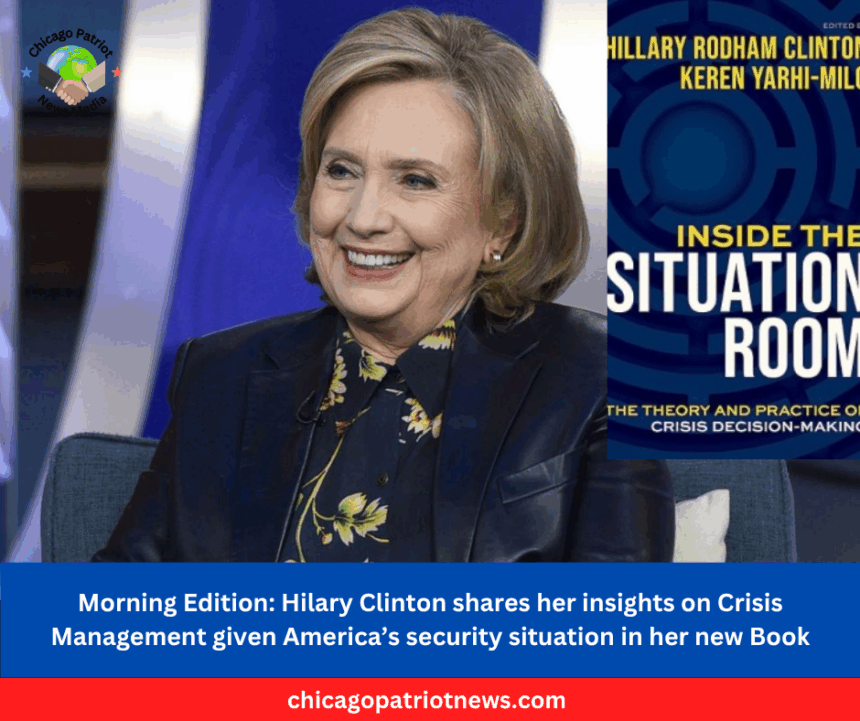
The book being discussed is titled Inside the Situation Room: The Theory and Practice of Crisis Decision‑Making, edited by Clinton and Yarhi-Milo. In an interview with Journalist Fareed Zakariya, Clinton discussed in detail her new book.
The book itself is published by Oxford University Press and draws on a combination of practitioners and scholars examining how leaders make decisions in crises.
Key Themes Discussed
Bridging theory and practice
Clinton and Yarhi-Milo emphasised that the book aims to narrow the gap between academic theory of decision-making in crises and the real-world practice of leaders.
During the interview, Zakaria asked about how the classroom experience at Columbia’s SIPA (School of International and Public Affairs) informed the book; Clinton noted that the course they co-taught helped shape many of the chapters. (The book launch announcement also references this. )
Mechanics and psychology of decision-making
The interview touched on specific elements such as the role of advisers, threat assessment, emotions in crisis, trust and face-to-face diplomacy, covert operations, and the influence of public opinion. These are also visible in the book’s table of contents.
Clinton remarked on how even seasoned decision-makers face unexpected pressures and how preparing for crisis involves more than just having data—there are behavioural, organisational and interpersonal dynamics.
Case studies and examples
Zakaria pressed Clinton on how the book addresses historical case-studies of crises (e.g., covert operations, diplomatic crises). While specific examples in the interview were limited, the book itself lists chapters on such cases (for example the bin Laden raid, a “Baghdadi operation”, Israeli-Palestinian conflict, etc.).
Women, leadership and decision-making
The interview thus situates the book more as a “master class” in decision-making rather than a memoir of any one crisis.
A portion of the discussion highlighted how the book pays explicit attention to women’s participation in security and decision-making processes. Clinton pointed out that gender remains an under-studied dimension in how crises are handled. The book includes a chapter on “Women’s Participation in Security Processes: A Strategic Imperative”.
Clinton emphasised that the perspectives and presence of women change the culture and practices of decision-making bodies.
Relevance to current global challenges
In the interview, the timing of the book was tied to the present moment: with multiple overlapping global crises (pandemics, wars, climate change, great-power competition), understanding how decisions get made is more critical than ever.
Zakaria asked about how the U.S. and world leaders can prepare for surprise or unanticipated crises; Clinton underscored the need for structures, trusted advisers, ready-made options, and scenario planning.