

Chicago – June 29, 2026
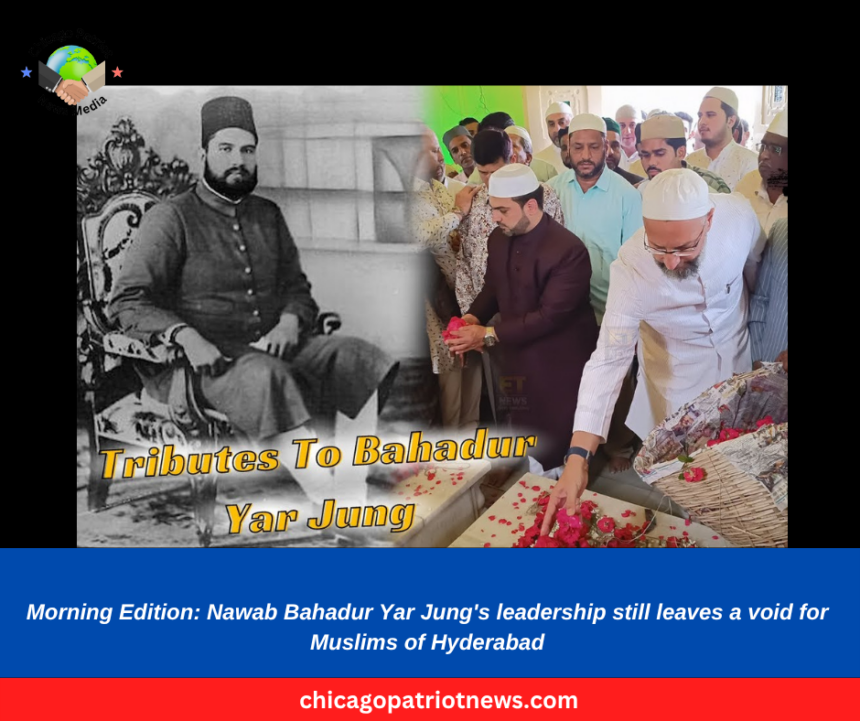
Nawab Bahadur Yar Jung (1905–1944) was born on 3 February 1905 into a distinguished aristocratic family in Hyderabad State. He belonged to the Paigah nobility, one of the most influential noble families serving the Nizams of Hyderabad. Raised in an environment that valued Islamic learning, public service, and leadership, he received a sound education in Arabic, Persian, Urdu, and English. From an early age, he displayed remarkable intelligence, a deep interest in religion, and exceptional public speaking abilities.
As a young man, Bahadur Yar Jung developed a strong commitment to the social, educational, and political advancement of the Muslim community in Hyderabad. His powerful oratory, intellectual depth, and charismatic personality quickly earned him widespread recognition. He became actively involved in public affairs and emerged as one of the most respected Muslim leaders of his generation.
In 1938, Nawab Bahadur Yar Jung was elected President of the Majlis-e-Ittehadul Muslimeen (MIM). He soon emerged as the most influential leader of the Muslim community in the erstwhile Hyderabad State and was honored with the title “Qaid-e-Millat” (Leader of the Nation).
A charismatic orator and visionary leader, Bahadur Yar Jung transformed the MIM from a limited political organization into a mass movement by promoting Muslim social, educational, and political awakening. He emphasized unity, community welfare, and constitutional participation while encouraging educational advancement and public service among Muslims. His inspiring speeches attracted large audiences across Hyderabad State and strengthened the organization’s influence. Under his leadership from 1938 until his untimely death in 1944, the MIM reached unprecedented prominence and became one of the most significant political organizations representing the Muslims of Hyderabad.
Nawab Bahadur Yar Jung died suddenly on 25 June 1944 after collapsing at a private gathering in Hyderabad. His unexpected death gave rise to speculation and rumors of assassination among sections of the public, but no conclusive evidence was ever produced to establish that he had been murdered. Contemporary investigations did not determine a definitive cause beyond his sudden death, leaving many questions unanswered and contributing to decades of public debate.
His passing was widely mourned across the Deccan, where thousands attended his funeral. Even today, Bahadur Yar Jung is remembered by many people in the Deccan for his powerful leadership, eloquence, and dedication to the social and political advancement of the Muslim community, and his absence is often regarded as a significant loss in the region’s history.
His legacy includes Dr. Qayyum Khan, Faiz Khan IT software engineer who are carrying forward his name as his third generation.